
The movie Interstellar grapples with faith and the grueling endurance it requires when it is put to the test by time and doubt.
As we witness the blood soaked horrors of the 21st century in real time, faith can be a difficult thing to hold on to. Why think that relief is coming, when history has made it abundantly clear that it never has? This problem is a bit unique for Christians, for our Holy Scriptures promise us that Christ will return one day, and that we will all rise from the dead to a glorious new existence, and that sickness and pain and death will be finally done away with. But it has been over 2000 years since that promise was made.
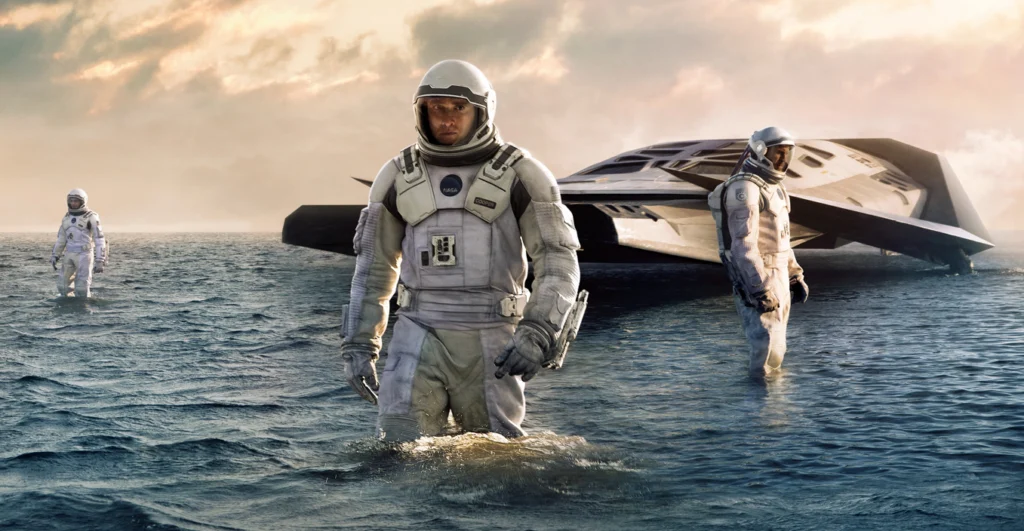
The struggle to persist in faith is a key theme in Christopher Nolan’s masterpiece film Interstellar. In this movie, Joseph Cooper, a former NASA pilot, accepts a mission to find inhabitable planets in another galaxy for the people of earth to populate, as Earth will soon be uninhabitable. Neither Cooper nor his kids (his daughter, Murph, and son, Tom) have any idea when (or if) he’s coming back, and so Murph, Tom and the rest of Earth’s population must wait in uncertainty for his return.
Long Delays and Lost Faith
The first planet that Cooper’s crew explores is called Miller’s planet, where 1 hour of time equals 7 years on earth due to time dilation. Things almost immediately go awry here, and the crew is forced to wait on Miller’s planet until the ship is ready to fly again. While for them, they only waited a few hours, the delay cost them 23 years of Earth’s time.
Cooper, knowing he just missed a large chunk of his kids’ lives, plays back all the messages he has received from them in that 23 year time span. He watches his son, Tom, grow from a 15 year old boy to a married man to a father. Eventually, it becomes clear that Tom son has stopped believing that he will return. Tom says:
“You aren’t listening to this, I know that. All these messages are just drifting out there in the darkness. Lois says that I have to let you go, and so I guess I’m letting you go. I don’t know wherever you are dad, but I hope that you’re at peace, and goodbye.”
That kind of message is jarring for us as a viewer, since we have been following Cooper’s mission from his perspective, and for him it’s only been around 3 hours on Miller’s planet. To see Tom lose faith in his father’s return in what seems like such a short time for us is devastating.
But think about it. Tom has been waiting on Earth for 23 years. That wait is a longer time span than all the 15 years he spent with his father. Our lives are measured in years, but they are lived in hours, minutes, and seconds, and each discrete bit of time presents us with the same demand to persevere in faith. Each morning, we wake up, and of course, there is no good news waiting for us. We start to question. Maybe we were fools to believe for so long.
Us Christians can relate to this struggle. In Revelation 22:7-21, Jesus declares, “And behold, I am coming soon”. Soon? It is now 2026. Generations and generations of Christians have come and gone since then, each believing themselves to be the last, each believing that they will see the second coming of Christ in their lifetimes.
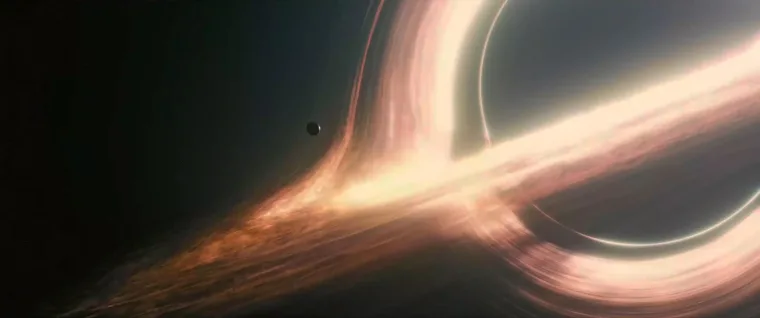
And the problem isn’t just eschatological. In John 16:23, Jesus says, “Very truly I tell you, my Father will give you whatever you ask in my name”. And so, we ask God for healing, or financial relief, or sanctification. And then we wait…and wait…and wait. Is God listening? Or are all our prayers just drifting out there in the darkness?
Abandoned
While Tom has lost faith, it seems that Murph still has some semblance of hope that her father will come back. In a message she sends to her father, she says,
“I never made one of these when you were still responding cause I was so mad at you for leaving. And then when you went quiet, it seemed like I should live with that decision, and I have. But today’s my birthday. And it’s a special one, because you told me…you once told me that when you came back we might be the same age. And today I’m the age you were when you left. So it’d be a real good time for you to come back.”
Ironically, though Tom has been sending all the messages until now, while Murph was silent, it is Tom who gives up on the prospect of his father returning. But Murph still hasn’t let her father go. Will her faith be rewarded? Sadly, not yet. Her faith crisis is about to get much, much worse.
Professor Brand, the genius behind the whole operation to save the people of earth and find a habitable planet, reveals a terrible secret to Murph on his deathbed. For years, Dr. Brand has told the staff at NASA that “plan A”, or the plan to rescue everyone on Earth and transport them to a habitable planet, is feasible. “Plan B”, or the plan to use frozen embryos to populate a habitable planet (while everyone on Earth perished) was supposed to be the last ditch backup. But it turns out that Professor Brand had given up on plan A for a long time. He tells Murph:
“You had faith. All those…all those years, I asked you to have faith. I wanted you to believe that your father would come back.”
But in the Professor’s eyes, that faith was misplaced from the start. He confesses,
“I lied, Murph. I lied to you. There was no need for him to come back. There’s no way to help us.”
As another scientist, Dr. Mann, later explains, Professor Brand lacked the means to obtain the data needed to solve the gravity equation. NASA needed the solution to this equation in order to create a spaceship which could transport all the people off of Earth. So Professor Brand abandoned plan A and settled for plan B, which is what Cooper’s mission was actually supposed to accomplish.
After the Professor dies, a heartbroken Murph sends another message to Cooper’s spacecraft, addressing both Amelia Brand (the daughter of the Professor and a member of Cooper’s mission) and Cooper. She says,
“Brand, did you know? He told you, right? You knew. This was all a sham. You left us here. To suffocate. To starve. Did my father know, too? Dad, I just want to know…if you left me here to die. I just have to know.”
Of course, Cooper cannot respond to her, as his messages don’t get back to Earth. So instead, he has to watch helplessly as his daughter begins to believe that her father abandoned her to save his own skin.
It’s difficult enough to persevere in faith when we must endure through long stretches of time without knowing when or if relief is coming. It’s even more difficult when we are presented with a reason to believe that our faith has been false all along. For Murph, it was discovering Professor Brand’s lie, and for Christians, it can be any number of intellectual objections and/or emotional doubts.
So maybe during these moments we start to seriously question our faith. Not only are we slogging through each day holding on to unfulfilled hope, but now we may be angry with God, and now we may be facing intellectual pressure to give up our beliefs. The allure of apostasy hangs over our heads.
While arguing with her brother, Murph reveals that she too has lost faith in her father’s return after the Professor’s fateful confession.
Tom says, “You’re gonna save everybody? Cause dad couldn’t do it.” And Murph responds, “Dad didn’t even try! Dad just abandoned us! He left us here to die.”
A Strange Sort of Providence
Are you familiar with the doctrine of divine providence? According to William Lane Craig, “Divine providence concerns God’s governance or supervision of the world-all that happens”.1 A good biblical example of this doctrine is Romans 8:28, in which Paul says, “And we know that in all things God works for the good of those who love him, who have been called according to his purpose.” So we can say that God providentially orders the events of history so that ultimately everything contributes to the flourishing of God’s children.
There is a kind of providence at work in Interstellar. During Murph’s childhood, all sorts of seemingly paranormal events happen in her bedroom. Books fall from her bookshelf at random without her having touched them, and one time they even spell out a message in Morse code, which reads: STAY. Murph thinks it is a ghost. Later, during a dust storm, the dust on the floor of Murph’s rooms spell out a message in binary. Once again, Murph believes that this is the work of her ghost, but Cooper believes that it is due to a gravitational anomaly. The dust message turns out to be coordinates to a top secret NASA facility, which Cooper and Murph travel to, and where Cooper is recruited for his mission.
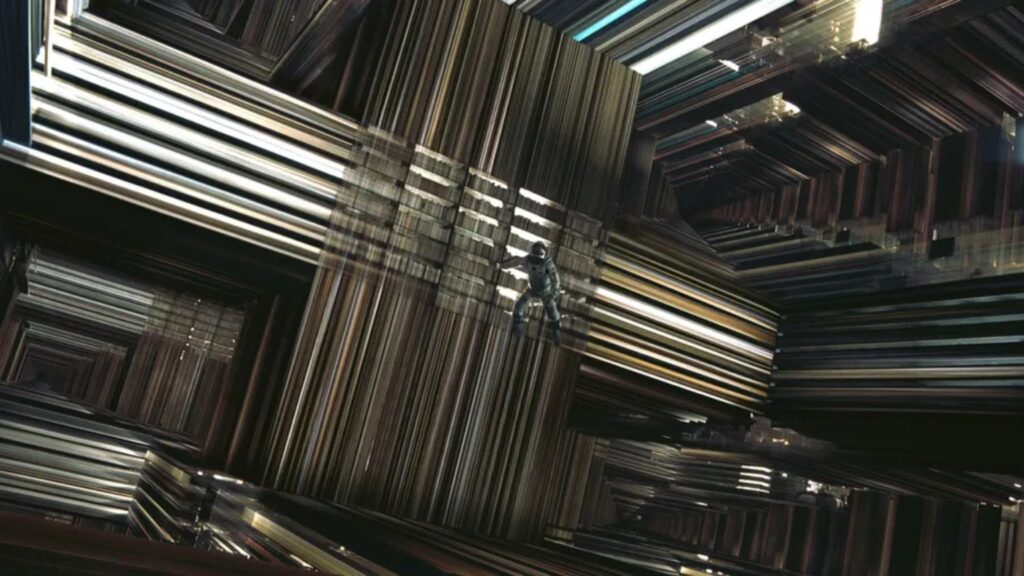
Much later in the movie, Cooper falls into a black hole, and finds himself in a tesseract structure which contains infinite copies of Murph’s bedroom from different moments in time. Cooper finds that he can manipulate gravity in Murph’s bedroom across time, enabling him to do things like push the books off of Murph’s bookshelf. At first, in grief from missing all those years of Murph’s life, he tries to get his past self to stay with Murph instead of leaving her to go on his mission. He pushes the books off of Murph’s bookshelf to communicate the message: STAY. Cooper turns out to be Murph’s ghost all along.
But Cooper can’t change the past. So he decides to use his power to try to save the future. He manipulates the dust in Murph’s room to communicate the coordinates to the NASA facility to his past self. And then, using Morse code, he transmits the data which was required to solve the gravity equation into Murph’s watch (which he gave her before he went on his mission, and which she left in her childhood bedroom). As an adult, Murph goes back to her room and recovers the watch, discovers the data, and uses it to complete the gravity equation, thus enabling humanity to construct the spacecraft needed to leave Earth.
When I first watched this scene, I couldn’t help but think of the doctrine of divine providence. In the tesseract, Cooper affects past phenomena in Murph’s bedroom, phenomena which are witnessed by his past self and past Murph. Witnessing the phenomena gets them to act, thus setting the events of the story in motion. Divine providence is kind of like this. God puts us in situations to get us to act, and then uses our actions to accomplish His purposes.
Moreover, God also allows evil to happen for good reasons. In the tesseract, Cooper was powerless to prevent his past self from leaving his daughter behind to go on his mission, but ultimately Cooper needed to go on his mission in order to save humanity. In a similar way, by allowing certain actions and events to happen, including sinful actions and horrible events, God can achieve great goods. So, after reuniting with his brothers who once threw him down a well, Joseph says confidently, “As for you, you meant evil against me, but God meant it for good” (Genesis 50:20).
So how does this relate to faith and doubt? Well, going back to Murph, she experiences a revival in her faith after finding the watch. In her childhood bedroom, she realizes that her dad was her ghost, and that her dad encoded the data into her watch for her to find. She then rushes out of the house, and exclaims to her brother,
“He came back! It was him, all this time, I didn’t know it was him. Dad’s gonna save us.”
It’s a beautiful moment, because Murph realizes that her father never abandoned her. Rather, all this time he was working to save her and the whole human race, and now he has given her the information needed to do exactly that.
So while we wait for the Lord, we must remember that God is working everything for good. He has not abandoned us. Rather, He is enacting His perfect plan to bring salvation and eternal joy to all who trust in Him. When He finally comes back, it will be the right time, the proper culmination of our divinely ordained story. And once we remember that, it becomes a little easier to wait, “knowing that in the Lord [our] labor is not in vain” (1 Corinthians 15:58). And instead of a watch as evidence of God’s providence, we have the Bible, God’s love letter to us, as well as the whole cosmos which testifies to us the glory, majesty and lovingkindness of the Lord.
- Craig, William Lane. “Doctrine of Creation (Part 10): Divine Providence.” Reasonable Faith, November 6, 2024. https://www.reasonablefaith.org/podcasts/defenders-podcast-series-4/doctrine-of-creation/doctrine-of-creation-part-10-divine-providence. ↩︎
Comments Off on Interstellar: A Test of Faith