Category: Movies

Interstellar: A Test of Faith

The movie Interstellar grapples with faith and the grueling endurance it requires when it is put to the test by time and doubt.

As we witness the blood soaked horrors of the 21st century in real time, faith can be a difficult thing to hold on to. Why think that relief is coming, when history has made it abundantly clear that it never has? This problem is a bit unique for Christians, for our Holy Scriptures promise us that Christ will return one day, and that we will all rise from the dead to a glorious new existence, and that sickness and pain and death will be finally done away with. But it has been over 2000 years since that promise was made. 

The struggle to persist in faith is a key theme in Christopher Nolan’s masterpiece film Interstellar. In this movie, Joseph Cooper, a former NASA pilot, accepts a mission to find inhabitable planets in another galaxy for the people of earth to populate, as Earth will soon be uninhabitable. Neither Cooper nor his kids (his daughter, Murph, and son, Tom) have any idea when (or if) he’s coming back, and so Murph, Tom and the rest of Earth’s population must wait in uncertainty for his return. 
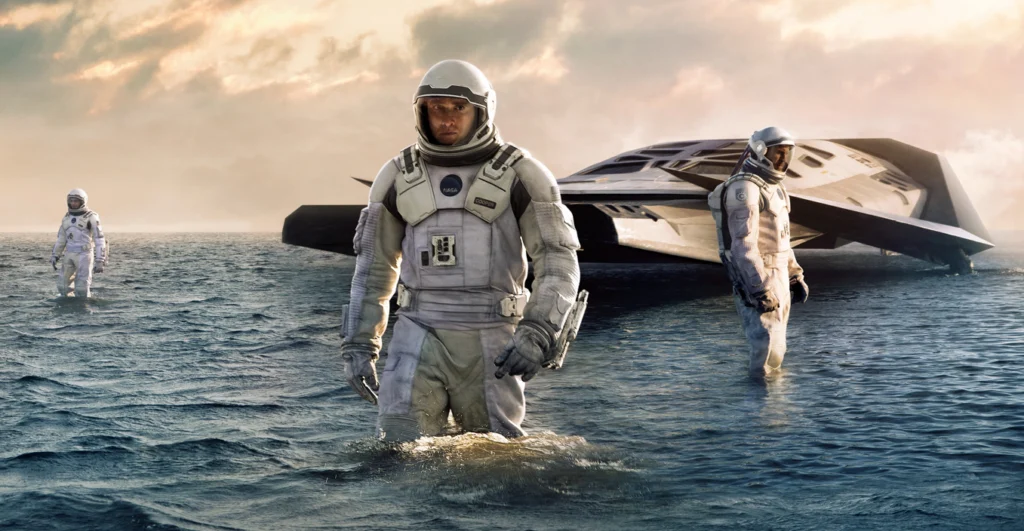
Long Delays and Lost Faith

The first planet that Cooper’s crew explores is called Miller’s planet, where 1 hour of time equals 7 years on earth due to time dilation. Things almost immediately go awry here, and the crew is forced to wait on Miller’s planet until the ship is ready to fly again. While for them, they only waited a few hours, the delay cost them 23 years of Earth’s time.

Cooper, knowing he just missed a large chunk of his kids’ lives, plays back all the messages he has received from them in that 23 year time span. He watches his son, Tom, grow from a 15 year old boy to a married man to a father. Eventually, it becomes clear that Tom son has stopped believing that he will return. Tom says:

“You aren’t listening to this, I know that. All these messages are just drifting out there in the darkness. Lois says that I have to let you go, and so I guess I’m letting you go. I don’t know wherever you are dad, but I hope that you’re at peace, and goodbye.”

That kind of message is jarring for us as a viewer, since we have been following Cooper’s mission from his perspective, and for him it’s only been around 3 hours on Miller’s planet. To see Tom lose faith in his father’s return in what seems like such a short time for us is devastating.

But think about it. Tom has been waiting on Earth for 23 years. That wait is a longer time span than all the 15 years he spent with his father. Our lives are measured in years, but they are lived in hours, minutes, and seconds, and each discrete bit of time presents us with the same demand to persevere in faith. Each morning, we wake up, and of course, there is no good news waiting for us. We start to question. Maybe we were fools to believe for so long. 

Us Christians can relate to this struggle. In Revelation 22:7-21, Jesus declares, “And behold, I am coming soon”. Soon? It is now 2026. Generations and generations of Christians have come and gone since then, each believing themselves to be the last, each believing that they will see the second coming of Christ in their lifetimes.

And the problem isn’t just eschatological. In John 16:23, Jesus says, “Very truly I tell you, my Father will give you whatever you ask in my name”. And so, we ask God for healing, or financial relief, or sanctification. And then we wait…and wait…and wait. Is God listening? Or are all our prayers just drifting out there in the darkness? 
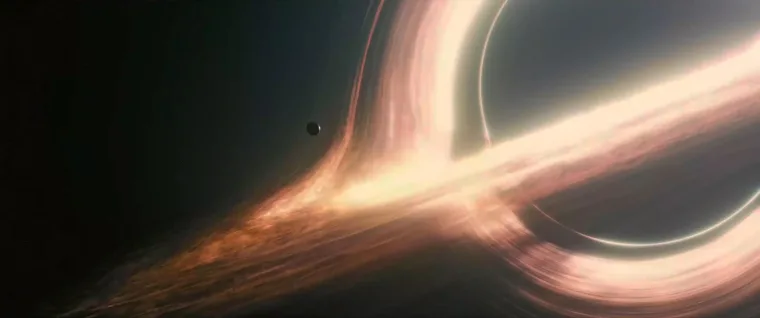
Abandoned

While Tom has lost faith, it seems that Murph still has some semblance of hope that her father will come back. In a message she sends to her father, she says,

“I never made one of these when you were still responding cause I was so mad at you for leaving. And then when you went quiet, it seemed like I should live with that decision, and I have. But today’s my birthday. And it’s a special one, because you told me…you once told me that when you came back we might be the same age. And today I’m the age you were when you left. So it’d be a real good time for you to come back.”

Ironically, though Tom has been sending all the messages until now, while Murph was silent, it is Tom who gives up on the prospect of his father returning. But Murph still hasn’t let her father go. Will her faith be rewarded? Sadly, not yet. Her faith crisis is about to get much, much worse.

Professor Brand, the genius behind the whole operation to save the people of earth and find a habitable planet, reveals a terrible secret to Murph on his deathbed. For years, Dr. Brand has told the staff at NASA that “plan A”, or the plan to rescue everyone on Earth and transport them to a habitable planet, is feasible. “Plan B”, or the plan to use frozen embryos to populate a habitable planet (while everyone on Earth perished) was supposed to be the last ditch backup. But it turns out that Professor Brand had given up on plan A for a long time. He tells Murph: 

“You had faith. All those…all those years, I asked you to have faith. I wanted you to believe that your father would come back.”

But in the Professor’s eyes, that faith was misplaced from the start. He confesses,

 “I lied, Murph. I lied to you. There was no need for him to come back. There’s no way to help us.”

As another scientist, Dr. Mann, later explains, Professor Brand lacked the means to obtain the data needed to solve the gravity equation. NASA needed the solution to this equation in order to create a spaceship which could transport all the people off of Earth. So Professor Brand abandoned plan A and settled for plan B, which is what Cooper’s mission was actually supposed to accomplish.

After the Professor dies, a heartbroken Murph sends another message to Cooper’s spacecraft, addressing both Amelia Brand (the daughter of the Professor and a member of Cooper’s mission) and Cooper. She says,

“Brand, did you know? He told you, right? You knew. This was all a sham. You left us here. To suffocate. To starve. Did my father know, too? Dad, I just want to know…if you left me here to die. I just have to know.”

Of course, Cooper cannot respond to her, as his messages don’t get back to Earth. So instead, he has to watch helplessly as his daughter begins to believe that her father abandoned her to save his own skin. 

It’s difficult enough to persevere in faith when we must endure through long stretches of time without knowing when or if relief is coming. It’s even more difficult when we are presented with a reason to believe that our faith has been false all along. For Murph, it was discovering Professor Brand’s lie, and for Christians, it can be any number of intellectual objections and/or emotional doubts. 

So maybe during these moments we start to seriously question our faith. Not only are we slogging through each day holding on to unfulfilled hope, but now we may be angry with God, and now we may be facing intellectual pressure to give up our beliefs. The allure of apostasy hangs over our heads. 

While arguing with her brother, Murph reveals that she too has lost faith in her father’s return after the Professor’s fateful confession. 

Tom says, “You’re gonna save everybody? Cause dad couldn’t do it.” And Murph responds, “Dad didn’t even try! Dad just abandoned us! He left us here to die.”
A Strange Sort of Providence

Are you familiar with the doctrine of divine providence? According to William Lane Craig, “Divine providence concerns God’s governance or supervision of the world-all that happens”.1 A good biblical example of this doctrine is Romans 8:28, in which Paul says, “And we know that in all things God works for the good of those who love him, who have been called according to his purpose.” So we can say that God providentially orders the events of history so that ultimately everything contributes to the flourishing of God’s children. 

There is a kind of providence at work in Interstellar. During Murph’s childhood, all sorts of seemingly paranormal events happen in her bedroom. Books fall from her bookshelf at random without her having touched them, and one time they even spell out a message in Morse code, which reads: STAY. Murph thinks it is a ghost. Later, during a dust storm, the dust on the floor of Murph’s rooms spell out a message in binary. Once again, Murph believes that this is the work of her ghost, but Cooper believes that it is due to a gravitational anomaly. The dust message turns out to be coordinates to a top secret NASA facility, which Cooper and Murph travel to, and where Cooper is recruited for his mission.

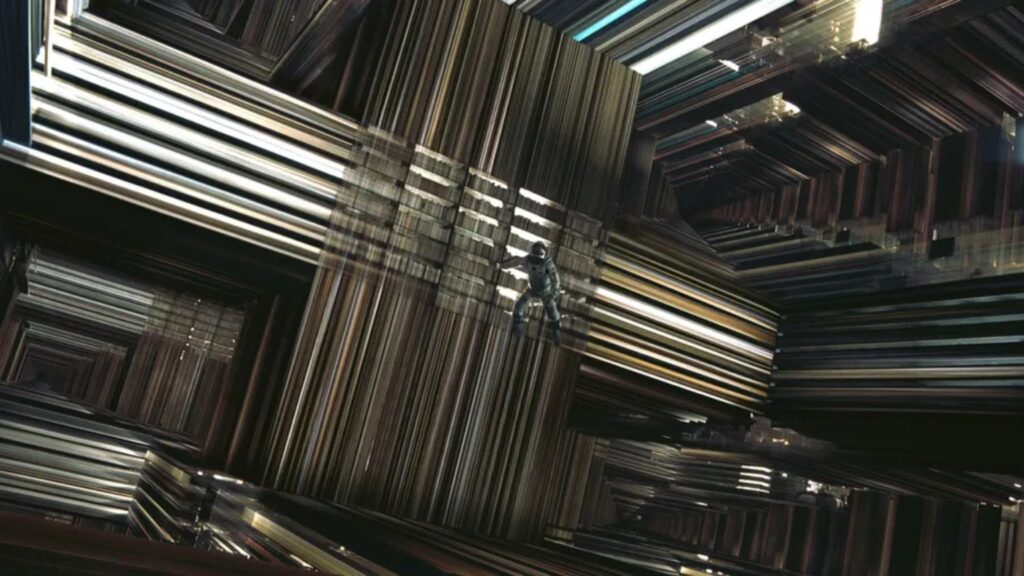
Much later in the movie, Cooper falls into a black hole, and finds himself in a tesseract structure which contains infinite copies of Murph’s bedroom from different moments in time. Cooper finds that he can manipulate gravity in Murph’s bedroom across time, enabling him to do things like push the books off of Murph’s bookshelf. At first, in grief from missing all those years of Murph’s life, he tries to get his past self to stay with Murph instead of leaving her to go on his mission. He pushes the books off of Murph’s bookshelf to communicate the message: STAY. Cooper turns out to be Murph’s ghost all along. 

But Cooper can’t change the past. So he decides to use his power to try to save the future. He manipulates the dust in Murph’s room to communicate the coordinates to the NASA facility to his past self. And then, using Morse code, he transmits the data which was required to solve the gravity equation into Murph’s watch (which he gave her before he went on his mission, and which she left in her childhood bedroom). As an adult, Murph goes back to her room and recovers the watch, discovers the data, and uses it to complete the gravity equation, thus enabling humanity to construct the spacecraft needed to leave Earth. 

When I first watched this scene, I couldn’t help but think of the doctrine of divine providence. In the tesseract, Cooper affects past phenomena in Murph’s bedroom, phenomena which are witnessed by his past self and past Murph. Witnessing the phenomena gets them to act, thus setting the events of the story in motion. Divine providence is kind of like this. God puts us in situations to get us to act, and then uses our actions to accomplish His purposes. 

Moreover, God also allows evil to happen for good reasons. In the tesseract, Cooper was powerless to prevent his past self from leaving his daughter behind to go on his mission, but ultimately Cooper needed to go on his mission in order to save humanity. In a similar way, by allowing certain actions and events to happen, including sinful actions and horrible events, God can achieve great goods. So, after reuniting with his brothers who once threw him down a well, Joseph says confidently, “As for you, you meant evil against me, but God meant it for good” (Genesis 50:20). 

So how does this relate to faith and doubt? Well, going back to Murph, she experiences a revival in her faith after finding the watch. In her childhood bedroom, she realizes that her dad was her ghost, and that her dad encoded the data into her watch for her to find. She then rushes out of the house, and exclaims to her brother, 

“He came back! It was him, all this time, I didn’t know it was him. Dad’s gonna save us.”

It’s a beautiful moment, because Murph realizes that her father never abandoned her. Rather, all this time he was working to save her and the whole human race, and now he has given her the information needed to do exactly that.

So while we wait for the Lord, we must remember that God is working everything for good. He has not abandoned us. Rather, He is enacting His perfect plan to bring salvation and eternal joy to all who trust in Him. When He finally comes back, it will be the right time, the proper culmination of our divinely ordained story. And once we remember that, it becomes a little easier to wait, “knowing that in the Lord [our] labor is not in vain” (1 Corinthians 15:58). And instead of a watch as evidence of God’s providence, we have the Bible, God’s love letter to us, as well as the whole cosmos which testifies to us the glory, majesty and lovingkindness of the Lord.

  1. Craig, William Lane. “Doctrine of Creation (Part 10): Divine Providence.” Reasonable Faith, November 6, 2024. https://www.reasonablefaith.org/podcasts/defenders-podcast-series-4/doctrine-of-creation/doctrine-of-creation-part-10-divine-providence. ↩︎
No Comments on Interstellar: A Test of Faith
Project Hail Mary

Project Hail Mary inspires questions about the cinematography of space, the existence of aliens, and the importance of sacrifice.

Project Hail Mary, a movie already receiving Oscar buzz for best actor, best picture, best visual effects, and many more, dropped into theaters this past Friday achieving a weekend box office of $140 million globally and $80 million domestically.1 The movie tells the story of Ryland Grace (Ryan Gosling), a reluctant but brilliant and underappreciated science teacher, who is recruited by NASA to fix the catastrophe of the sun dying due to a bacteria called Astrophage that is eating our sun. It turns out that Astrophage is not only eating the Milky Way’s star, but other stars as well. So, in desperate need to save earth, Grace is sent to another galaxy’s star – Tau Ceti – where he meets an unlikely friend named Rocky.

The movie is an achievement in all areas, deserves Oscar nominations, and is worth the money to go see in theaters! The movie also makes me want to dive into Andy Weir’s novel which the movie is based off of, and has inspired three main thoughts regarding the cinematography of space, the existence of aliens, and lastly, the thematic importance of sacrifice throughout the film.

The Heavens Declare the Glory of God

The film begins with a phenomenal portrait of space, or of what one should call “the heavens.” The visuals, screenwriting, and cinematography do not hate space! While many space movies portray space as a dark nothingness that wants to kill us, this movie is more optimistic and portrays visuals that are hauntingly reverent. Today, our culture thinks of space much like the writers of the Ancient Near East thought of water as primeval dark chaos, something deadly and itself lifeless, and something that destroys our order.2 While some may still fear water, our culture at large does not fear it. However, we do fear space.

Grace, when he wakes up on the ship, also fears it; although, this may be due to him being alone without his past memories, not necessarily because he fears space, as later on in the movie, he is comfortable and maneuvers space as if it is his home or a regular street on earth. The cinematography captures the life-giving nature of space when it pans forward to reveal a heavenly painting of galaxies and stars set before Grace’s eyes:

Space should not be thought of as a deadly dark void; rather, it should be viewed as something that has a voice, a life-giving voice that makes us aware of the beautiful artist that painted it! We ought to return to gazing at the stars and feeling the immense grandeur of the heavens that our home floats in. Oddly enough, this was the intention of the directors, Phil Lord and Christopher Miller:

“One thing about this story that’s unique is that a lot of films are about someone who feels at home on Earth, wakes up in space, and they feel lonely. This is a movie about someone who feels lonely on Earth. They go to space and find a friend. We wanted space to be, in a funny way, inviting. The old vacuum of space is actually warm and inviting. You’re closer to heaven. The way the film is textured visually, we wanted it to feel more homey.”3

The directing, acting, and dazzling cinematography achieve this invitation to ponder space not as lonely but as a warm home that “brings us closer to heaven.” I argue that it doesn’t just bring us closer to heaven, it is the heavens! C.S. Lewis, in Out of the Silent Planet, uses the character Ransom to explore the misnaming of space. Ransom, just like Grace, wakes up in a spaceship and experiences the vastness of the heavens. Lewis writes:

“He could not call it ‘dead’; he felt life pouring into him from it every moment. How indeed should it be otherwise, since out this ocean the worlds and all their life had come? He had thought it barren: he saw now that it was the womb of worlds, whose blazing and innumerable offspring looked down nightly even upon the earth with so many eyes – and here, with how many more! No: space was the wrong name. Older thinkers had been wiser when they named it simply the heavens – the heavens which declared the glory.”4

Lewis is right. When I look at photos from NASA’s Hubble Telescope, or go stargazing, or when I watch interstellar movies, I do not think of space as “space.” Simple “space” does not cause reverence within me nor does it cause me to feel the presence of God. Grace in the movie asks Eva Stratt, the leader of Project Hail Mary, if she believes in God. She replies, “it beats the alternative.” While that sentiment is most definitely true, a more confident reply could be given. The heavens scream from the top of their lungs that God exists! The only question is if our ears are attuned enough, and not blocked, so that we can hear the voice of the heavens.

While I do feel the presence of God while gazing at the stars, I also do wonder if there is more than just us human beings.

Are There and Should There be Aliens?

Our culture is fascinated with the idea of extraterrestrial life, especially extraterrestrial intelligent life (ETI). From NASA and SpaceX to countless movies and novels to academic and unhinged podcasts, we all ponder if we are alone in this universe. Around 65% of American adults think life exists outside of our planet.5 Historically, when we thought of Aliens, we always connected malicious intent and danger with them; however, Project Hail Mary reverses that! The trailers make it known that Grace forms a deep friendship with Rocky and while Project Hail Mary is not the only story to portray Aliens as loving and safe, it is one of the only ones that has stirred this question in my mind: if there does exist ETI, are they sinful? This question does presuppose some metaphysical conditions of our world, namely the fall and that our human nature is inclined to sin. It also engages the wider discussion of whether or not theism, and the Christian story in particular, is compatible with ETI. Interestingly, those who are religious are less likely to believe in ETI.6 However, religious folk need not worry that ETI is incompatible with their faith.

Historically, Christians have not seen other life forms as contrary to the faith. During the medieval church, there existed the medieval dictum “bonum est diffusivum sui” (roughly “goodness is self-diffusive”), which argued that God’s goodness implies that He created an infinite number of worlds with an infinite number of creatures so that His goodness could be shared. Even today, massively influential figures like Billy Graham and Pope Francis believe in the possible existence of aliens.7 Once one allows for the existence ETI, fun theological questions arise: to what extent did the fall of both Satan and the fall of humanity affect the universe; if there are fallen alien creatures, does Christ save them in the same manner He saves us; if so, could Christ take on multiple incarnations (interestingly, giants of the faith like Augustine, Aquinas, and Bonaventure thought yes);8 what kind of natures would these creatures have; could what we mistake as aliens be us interacting with the spiritual realm; would they have their own scripture?; and what other creations, like what unimagined, humanly impossible colors, exist?

Answering these questions would take essay upon essay so I leave them for you to ponder; however, the answer to the question that arose in my mind while watching Project Hail Mary is no; I currently see no reason why ETI would have to necessarily be sinful.

WARNING: SPOILERS AHEAD!

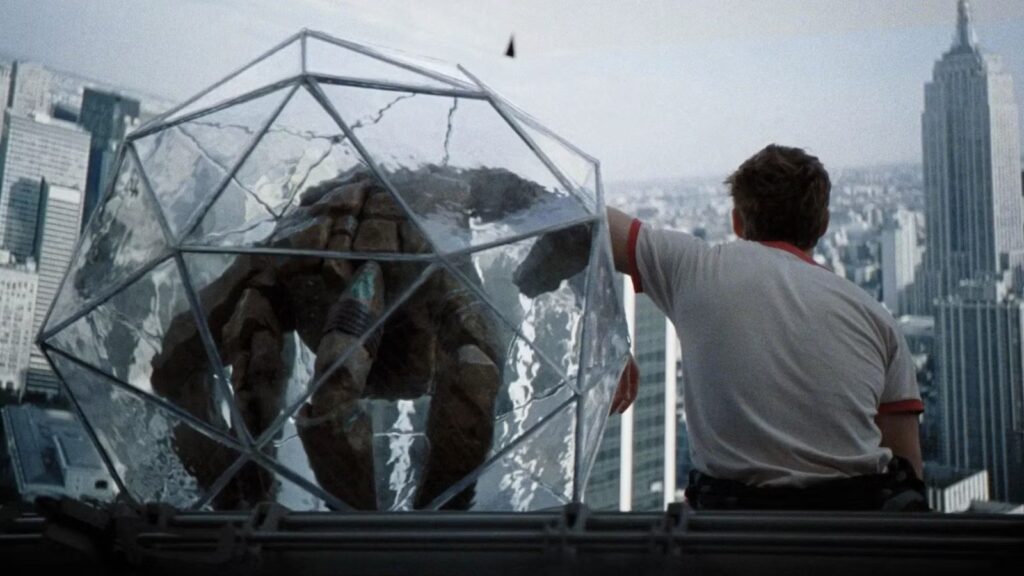
Before watching Project Hail Mary I never thought that I would care so much about a faceless rock creature but, as a good movie does, I slowly began to find this character extremely endearing. Rocky does not give off a scent of sin. He first seeks out Grace even though he does not know if Grace is a threat or not, Rocky is deeply saddened by the death of his fellow crew that were on his ship, lives on what seems to be a peaceful, sin-free planet, and he ends up displaying an incredible act of love for Grace. There already does exist unfallen creatures in this fallen world (e.g. Archangels Michael and Gabriel). C.S. Lewis explored in Out of the Silent Planet the existence of unfallen creatures and I see no theological, historical, practical, or philosophical reasons why such creatures could not exist. And if such creatures do exist, then they could display great acts of love such as self-sacrifice.

Sacrifice

WARNING: SPOILERS AHEAD!

The movie is centered around friendship and this friendship builds into a deeply moving climax. Due to a fuel leak that leads to Astrophage causing the ship to spiral into chaos, Grace is knocked out by the chaos and is left for dead while Rocky is still conscience. However, Rocky cannot escape his bubble without risking death due his physical nature being entirely made up of metal with oxides. If he leaves his bubble, he will essentially catch fire due to the oxygen. Rocky, fully knowing this, risks his life to save Grace.

Later on, after recovering and heading their separate ways, Grace finds out that the Taumoeba (the predator of the Astrophage) is able to escape Rocky’s ship which would leave Rocky and his planet doomed. Grace, who was forced into this mission and did not want to sacrifice himself for his own human race, chooses to sacrifice himself and go back to save Rocky and his people. This pulls at one’s heart, completes a great character arc for Grace, and demonstrates the altruistic narratable desire that all humans have… to be told a story about sacrifice! However, there is one glaring element that is missed in the story.

The Sacrifice of both Rocky and Grace are not of the highest sacrificial order. Grace has amnesia for the whole movie, but near the end we, alongside Grace, learn that he was cowardly and selfish as he could not muster any courage to sacrifice himself for the betterment of his planet. In a flashback scene, Grace speaks with one of the astronauts that is going on the mission and tells him that that he admires the gene that makes him brave. The astronaut responds, “It’s not a gene, you just have to have someone to be brave for.” The bravery and love that Rocky and Grace have is the love of friends, something admirable and beautiful, but there is a deeper love. The Apostle Paul writes:

Very rarely will anyone die for a righteous person, though for a good person someone might possibly dare to die. But God demonstrates his own love for us in this: While we were still sinners, Christ died for us. Since we have now been justified by his blood, how much more shall we be saved from God’s wrath through him! For if, while we were God’s enemies, we were reconciled to him through the death of his Son, how much more, having been reconciled, shall we be saved through his life! (Romans 5:7-10).

We love because He first loved us, and His love is unconditional, a love that is foolish to our human intuition because it dies for it’s enemies. Neither Rocky nor Grace die for their enemies, Grace could not even die for his acquaintances. The love of God is unique and radical. It is something we all desire, to be loved even though we ourselves are often unlovely. This is the Gospel – that we are reconciled to God through Himself and for Himself so that we can learn to be like Him and share such unconditional love with the world. We all have a human itch for this love and while Project Hail Mary does not portray love for enemies, it does satisfy this itch of sacrificial love and is why the movie is phenomenal as all great movies reveal and copy the meta-truths and meta-narrative that we live in.

  1. Rubin, Rebecca. “Box Office: Ryan Gosling’s ‘project Hail Mary’ Scores Biggest Debut of Year with $80.5 Million, Sets Amazon MGM Record.” Variety, March 22, 2026. https://variety.com/2026/film/box-office/project-hail-mary-box-office-biggest-debut-2026-amazon-mgm-record-1236696247/. ↩︎
  2. Thanks to my friend Michael Hamilton for this connection to Ancient Near Eastern Literature. ↩︎
  3. Thomas, Lou. “Phil Lord and Chris Miller on Project Hail Mary: ‘We Wanted the Movie to Feel like You Were in the Guts of a Machine.’” BFI, March 13, 2026. https://www.bfi.org.uk/interviews/phil-lord-chris-miller-project-hail-mary. ↩︎
  4. C. S. Lewis, Out of the Silent Planet (New York: Scribner, 2003), 34. ↩︎
  5. Kennedy, Courtney, and Arnold Lau. “Most Americans Believe Life on Other Planets Exists.” Pew Research Center, June 30, 2021. https://www.pewresearch.org/short-reads/2021/06/30/most-americans-believe-in-intelligent-life-beyond-earth-few-see-ufos-as-a-major-national-security-threat/. ↩︎
  6. Alper, Becka A., and Joshua Alvarado. “Religious Americans Less Likely to Believe Intelligent Life Exists beyond Earth.” Pew Research Center, July 28, 2021. https://www.pewresearch.org/short-reads/2021/07/28/religious-americans-less-likely-to-believe-intelligent-life-exists-on-other-planets/. ↩︎
  7. C. A. McIntosh and Tyler Dalton McNabb, “Houston, Do We Have a Problem? Extraterrestrial Intelligent Life and Christian Belief,” Philosophia Christi 23(1), 2021, 113-114. ↩︎
  8. Ibid., 109. ↩︎
No Comments on Project Hail Mary

Frankenstein (2025)

Guillermo del Toro’s Frankenstein (2025) teaches us about death, faith in science, divine hiddenness, and forgiveness.

Guillermo del Toro’s Frankenstein (2025) is a masterpiece and worthy of an Oscar. In fact, it is nominated for nine Oscars and, without a doubt, will win at least a couple. The film tells the well known story of Victor Frankenstein’s mad, ego driven desires to conquer death, and how, in the process, he creates a monster whom he abandons. I cannot comment on how similar the movie is to Mary Shelley’s 1818 novel as I shall have to wait until after grad school to checkmark that off my reading list. However, there are four important themes throughout the film that I wish to comment on: death, faith in science, divine hiddenness, and forgiveness.

DEATH

In the film, Victor has a callous but scientifically brilliant father and a soft and loving mother. The abandonment of his father creates the medical complication that kills Victor’s mother during the childbirth of his younger brother William. This death, and Victor’s failing to save her, puts into him the motivation to overcome mortality. Oddly enough, death may be what motivates all of us in all that we do.

The Pulitzer prize winning archeologist Ernest Becker states, “the idea of death, the fear of it, haunts the human animal like nothing else: it is the mainspring of human activity – activity designed largely to avoid the fatality of death, to overcome it by denying in some way that it is the final destiny of man.”1 He continues, “all culture, all man’s creative life-ways, are in some basic part of them a fabricated protest against natural reality, a denial of the truth of the human condition, and an attempt to forget the pathetic creature that man is.”2

All culture is shaped by death, without it, culture would not exist. Most of our choices are subconsciously shaped by death. Hedonistic pleasure, virtuous pursuits, our stories, our health, our relationships, and our religious devotion (both atheistic and theistic) are all driven by the inevitable future that death overtakes all. Death, it terrifies us into searching for life.

Ancient stories echo this terror. In the Ancient Epic of Gilgamesh, Gilgamesh says, “how can I rest, how can I be at peace? Despair is in my heart. What my brother is now, that shall I be when I am dead. Because I am afraid of death.”3 The critic in Ecclesiastes groans over death and suffering and its seemingly unfair character, and even states that it is better for one to never have been born at all (Ecc. 4:3). Today, more than five hundred studies demonstrate that we are deeply affected by the terror of our knowledge of our own mortality.4 Death can be a great thing to meditate on (Ecc. 7:4), but we often choose incapable and damaging antidotes when we should choose Him as the antidote.

Victor, while presenting his ability to raise the dead to university faculty, beckons, “God is inept, and we must correct his mistakes!” This causes the university to expel him; however, he finds a funder in Heinrich Harlander, and both turn to science to settle their despair over death.

FAITH IN SCIENCE

Frankenstein has always been taken as a cautionary tale against scientific ambition and the people who, as Elizabeth says, “play God”. Today, the scientific ambition to play God is at an all-time high. Transhumanism, a philosophical movement that seeks the promise of immortality through technologies’ ability to overcome human limitations, is where Victor puts his faith. Today’s pioneers do the same. Oracle cofounder Larry Ellision donated $430 million to antiaging research, and Alphabet CEO Larry Page started Calico with a $750 million investment for life-extension research.5

Some put faith into “brain-uploading”. David J. Chalmers, professor of philosophy and neural science at New York University, states that one day, during the “singularity”, that we will be able to upload our brains to a computer, giving us immortality. However, Chalmers also recognizes that we have no idea how to go about consciousness and therefore, brain uploading. He says, “it is true that we have no idea how a nonbiological system, such as a silicon computational system, could be conscious. But the fact is that we also have no idea how a biological system, such as a neural system, could be conscious. The gap is just as wide in both cases.”6 Transhumanism relies on the metaphysical commitment of materialism, but perhaps we have this wide gap because we are much more than simply material beings.

Any time we reduce man to material, we will end up in evil. Victor states, “In seeking life, I created death.” Instead of seeking life Himself, he created a monster. However, del Toro does not think of monsters as most do.

A MARCIONITE DIVINE HIDDENESS

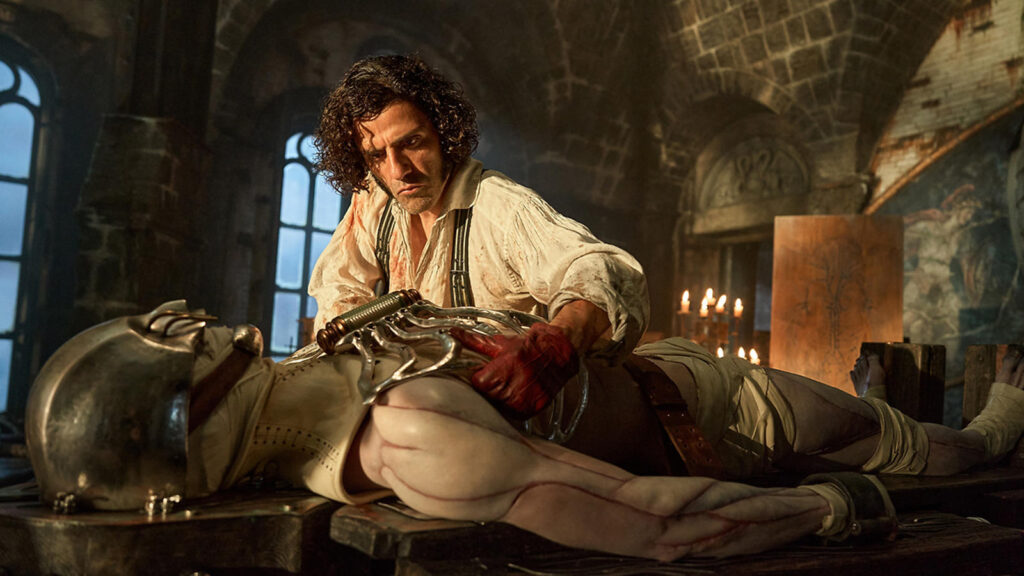
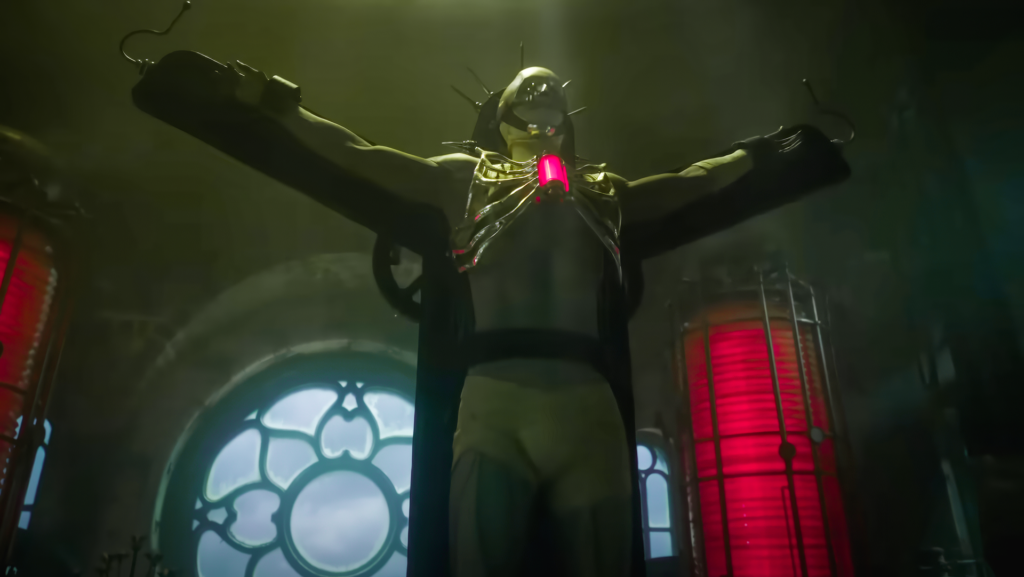
Del Toro connects more with monsters than with Jesus. He says, “monsters are my religion… my grandma has Jesus. I have Boris Karloff. He was my Messiah.”7 He also thinks of monsters as patron saints and sees Frankenstein as Christ. One only has to look at the striking imagery of the monster being crucified:

However, under this framework, he conjures a Marcionite-like heresy where Victor is a careless and angry creator who gave no thought to what would come after his creation and the creature is Christ whom comes with love and salvation. It seems that the creator is the one who needs forgiveness, not creation. It seems that it seems as though it is the creator’s fault for the suffering we experience and not creation’s rejection of their creator. The creator abandons his creation and his creation yells “VICTOOOOOOOOOR!” The chasm we see between the divine and us is a true reality, but it is not the creator’s fault.

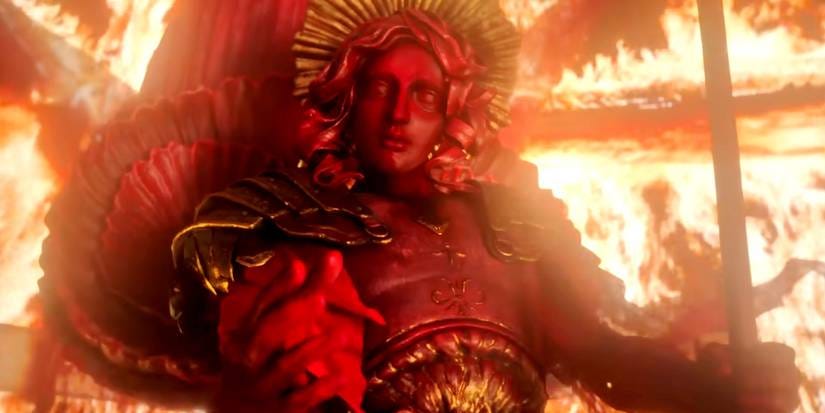
Victor as a child prayed to the archangel Michael as he bowed to a comforting statue of him. However, a bloody, dark angel visits him to inspire his journey of overcoming death. Victor should not be thought of as a God who abandons His creation, rather he should be pictured as Adam and Eve who listened to the dark serpent that told them they won’t die. Victor is us humans who miss the mark in the plethora of ways we try to achieve life.

In the Christian story, it is the Father who had a plan all along to reconcile His creation back to Himself, the plan that the seed of the women would crush the head of the snake (Gen. 3:15). And even del Toro seems to maybe hint at this plan near the end of his film.

FORGIVENESS

Del Toro, a lapsed catholic, cannot rid himself of the Christian ideal of forgiveness. While he may paint God as a negligent creator, the message of forgiveness, that is so central to the Christian faith, is the story’s message as Victor ends saying:

“Forgive me. My son. And if you have it in your heart, forgive yourself into existence. If death is not to be, then consider this, my son. While you are alive, what recourse do you have but to live? Live. Say my name. My father gave me that name, and it meant nothing. Now I ask you to give it back to me… one last time. The way you said it at the beginning. When it meant the world to you.”

The creature responds, “Victor. I forgive you. Rest now, Father. Perhaps now, we can both be human.”

We must forgive ourselves into being. If we do not forgive each other and ourselves, we cannot have life. The Psalmist writes:

When I kept silent about my sin, my body wasted away
Through my groaning all day long.
For day and night Your hand was heavy upon me;
My vitality was drained away as with the fever heat of summer. Selah.
I acknowledged my sin to You,
And my iniquity I did not hide;
I said, “I will confess my transgressions to the Lord”;
And You forgave the [f]guilt of my sin. Selah.
Therefore, let everyone who is godly pray to You in a time when You may be found;
Surely in a flood of great waters, they will not reach him.
You are my hiding place; You preserve me from trouble;
You surround me with [h]songs of deliverance. Selah (Ps. 32:3-7).

If the creature does not forgive, he will waste away along the bitter, groanful road of unforgiveness that leads only to sheol, the realm of the dead. However, once the creature forgives, he is able to look upon the sun, which, as Victor said, is life. May we, through these stories that shadow the real story, realize the forgiveness we have in Christ as His light preserves, delivers, and gives life to all those brave enough to look upon the Son.

  1. Ernest Becker, The Denial of Death, (New York: Free Press, 1973), xvii. ↩︎
  2. Ibid, 32-33. ↩︎
  3. The Epic of Gilgamesh, translated by N.K. Sanders, (New York: Penguin, 1972), 42. ↩︎
  4. Sheldon Solomon, Jeff Greenberg, and Tom Pyszcynski, The Worm at the Core: On the Role of Death in Life, (New York: Penguin, 2006), 10-11. ↩︎
  5. Arina Eunjung Cha, “Tech Titans’ Latest Project: Defy Death,” Washing Post, April 4, 2015. ↩︎
  6. David Chalmers, “The Singularity: A philosophical Analysis,” in Science fiction and Philosophy From Time Travel to Superintelligence, 2nd. Ed. Susan Schneider (West Sussex, UK: Wiley, 2016), 203. ↩︎
  7. https://bgindependentmedia.org/mexican-director-del-toro-frames-frankenstein-as-a-father-son-psycho-drama/#:~:text=Review%20by%20CARROLL%20McCUNE,doing%20a%20horror%20movie%E2%80%94ever. ↩︎

Comments Off on Frankenstein (2025)

Batman V Superman (2016) and its Missed Theological Message – Part 2

Batman V Superman explores the rejection and willful death of the Godman who became incarnate to redeem those who were lost.

Previously, in part one of this article series, we introduced the argument that the message of Batman V Superman was missed by most of the general audience due to theological apathy and biblical illiteracy. We then dove into the problem of evil, how the foundation for morality has been stripped away, and how Batman is a Nietzsche inspired Übermensch and Killer of God. We now turn Batman’s redemption in Superman.

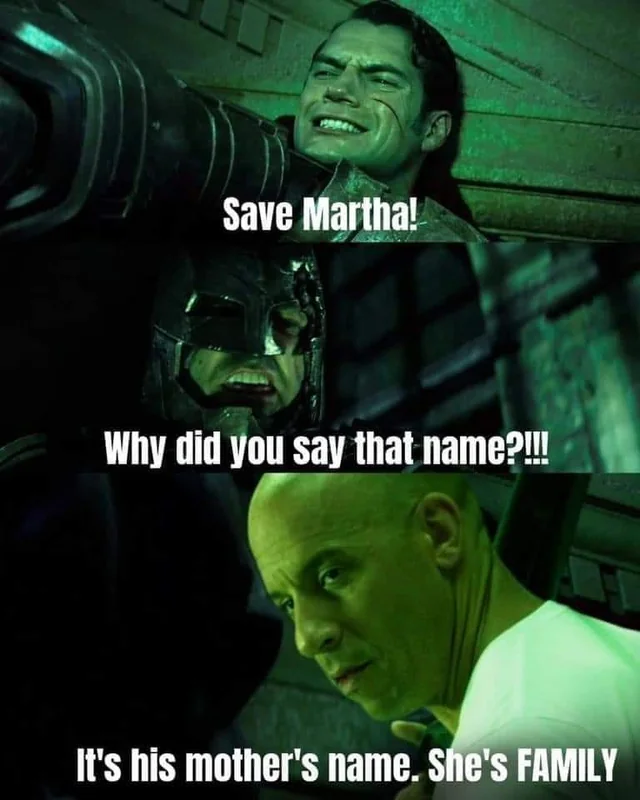
WHY DID YOU SAY THAT NAME!

While we all made fun of the infamous Martha moment in Batman V Superman, and while it can come off as cheesy, I do think we missed what Zack Snyder was trying to convey.

Batman hates Superman for not being a man, for being deistic, for not being able to relate or to care for humankind. Batman, while fighting Superman, states, “You’re not brave… men are brave. You say that you want to help people, but you can’t feel their pain… their mortality… It’s time you learn what it means to be a man.” At the end of the fight, when Batman is about to kill Superman, he says, “You were never a god, you were never even a man.”

What Bruce Wayne misses is the fact that Superman is human, that he has emptied himself to become a servant, he has wept, he is a man who knows sorrow well, he can sympathize with our weaknesses, he has felt the pain that the Problem of Evil brings. He is not a deistic god who cares not about his people. Rather He is God in the flesh; he is a God who has a mother. It is at this moment in which Batman’s heart changes. Bruce sees Clark beg to save his mom, Martha. Zack Snyder states:

“The Martha moment… is Bruce’s opportunity to reconnect with his own humanity and the humanity of Superman. Batman doesn’t end the fight because their mothers have the same name, but because he recognizes Superman as someone with a mother, and thus a human, despite his alien origins. The battle against Superman is ultimately Bruce’s realization that he can be better and reconnect with humanity again. It’s not a redemption, or a full change, as he does kill mercenaries at the warehouse in the following scene, but it is a start.”1

Batman realizes that Superman shares his humanity; it is the realization of the Incarnation that changes Batman. He realizes that God is not far from our suffering, but is with us in it! Now while Batman still kills, he does eventually return home to his no-kill rule in the Justice League. He finds his true humanity again, a humanity that is transformed and likened to Superman or to Christ.

Superman and the Death of Christ

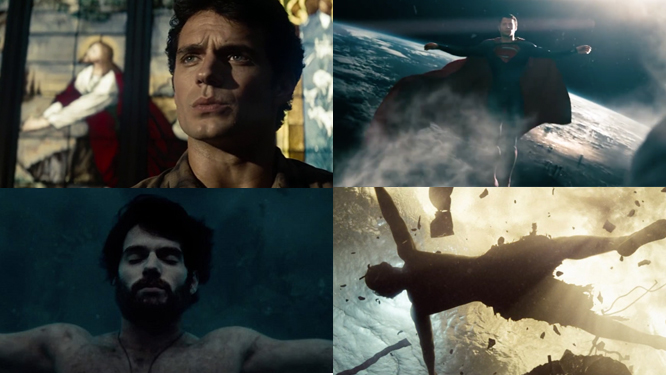
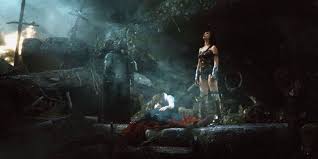
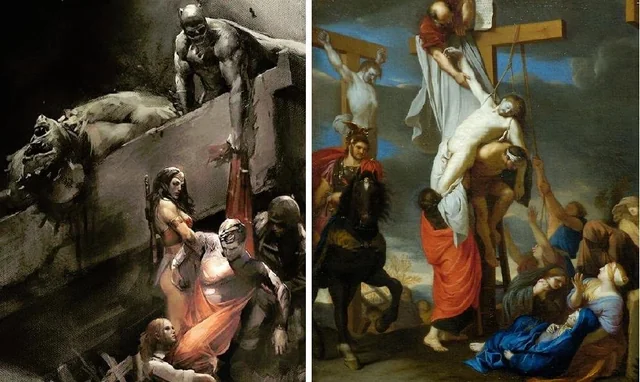
The religious imagery and comparison of Superman to Christ is obvious throughout both Man of Steel (2013) and Batman V Superman. One only has to look at the images below to understand what Zack Snyder is doing:

The original creators of Superman, Jerry Siegel and Joe Shuster, created Superman as Moses-figure. Superman has since been seen as both a Moses and a Christ-figure. In Hebrew, Kal-El, Superman’s Kryptonian name, means “Voice of God”. In Man of Steel, he is thirty-three years of age when he begins making public his Superhero activities. Another powerful image is when Jor-El (Superman’s Kryptonian father) says to Superman, “You can save all of them.” Superman then extends his arms from his sides in a crucifix before going to save humanity from destruction. The Christ imagery is blunt and obvious.

Another comparison to Christ is the fact that Superman chooses to save humanity. His mother, Martha Kent, states, “Be their hero, Clark. Be their angel, be their monument, be anything they need you to be… or be none of it. You don’t owe this world a thing. You never did.” Superman could easily regret ever coming to earth and forgo the saving of humanity. God could regret that he ever made mankind and flood the earth once again, but he does not! Rather, he willingly submits to suffering:

Do you think I cannot call on my Father, and he will at once put more than twelve legions of angels at my disposal? – Matthew 26:53

No one takes it from me, but I lay it down of my own accord. – John 10:18

But when the goodness and loving kindness of God our Savior appeared, he saved us, not because of works done by us in righteousness, but according to his own mercy. – 1 Timothy 3:4

Superman willingly chooses to save humankind from Doomsday even though he knows that it will cost him his life. Zack Snyder and the concept artists position religious imagery to evoke Superman as the Christ:

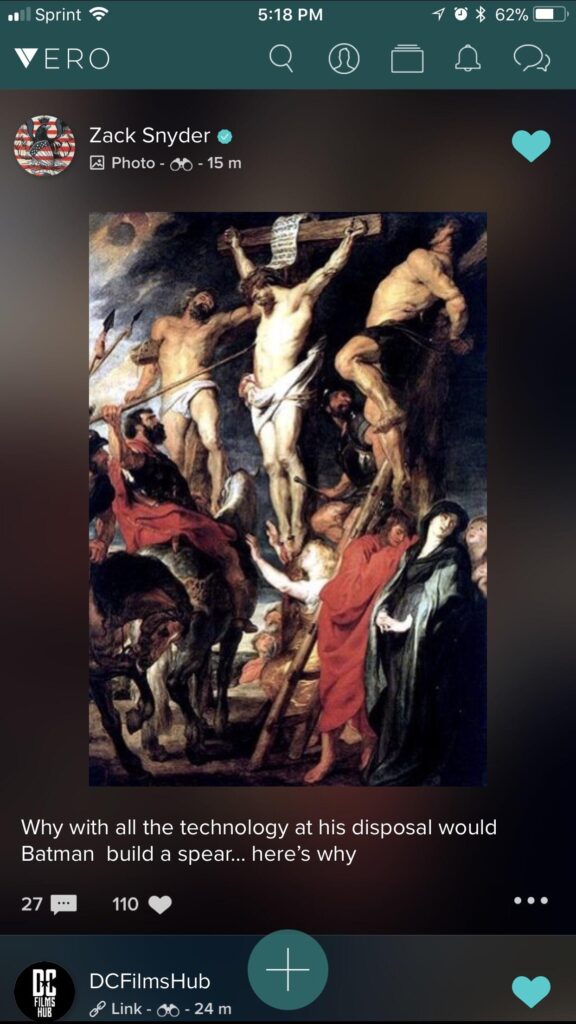
Lastly, one of the most striking symbols is the kryptonite spear. A fan asked Zack Snyder on Twitter why Batman, with all the technology he has at his disposal, chose a spear to be the weapon that kills Superman. Zack Snyder responded:

Again, back to the thesis, the general audience, due to theological apathy and biblical illiteracy, did not understand the religious discussion going on within Batman V Superman! When one grasps the imagery and the tough questions that the movie asks, the movie becomes so much more than just a superhero blockbuster movie. It becomes an exploration of the rejection and willful death of the Godman who became incarnate to bear the problem of evil itself and to redeem those who were lost.

The Justice League as Christian Saints

Batman is the one who was redeemed by the Godman. At Clark Kent’s funeral, the hymn “Amazing Grace” plays in the background. The lyrics go as follows:

Amazing grace how sweet the sound

That saved a wretch like me

I once was lost, but now I’m found

Was blind but now I see

Batman had become cruel; he had become an Übermensch who thought he could will to power his way out of his nihilism. Bruce Wayne was a wretch who branded and killed his enemies, but he was changed by the Godman. One could say that he was as blind as a bat, but now he sees.

Bruce Wayne, while talking to Diana (Wonder-Woman), states, “I’ve failed him… in life. I won’t fail him in death. Help me find the others like you.” Batman, who failed the Godman, is now honoring him with his life and is commissioned to find the others (the Justice League); one could say that he embarks on a great commission to find those that have been called by the death of the Godman, leaving them an example, so that they might follow in the Godman’s steps.

However, the Justice League knows that they cannot do this without Superman. Bruce states in the Justice League, “The world needs Superman… the team needs Clark.” Even the villains know that Superman is needed. Steppenwolf, in the Justice League, only comes to earth due to Superman’s death. He says, “No protectors here. No Lanterns. No Kryptonian. This world will fall, like all the others.” Without Christ, our world will fail. But Bruce knows that the death of the Godman is not where the story ends.

The Second Coming

In the ultimate edition of Batman V Superman, the Priest during Clark Kent’s funeral cites Isaiah 26:19: “But your dead will live, LORD; their bodies will rise — Let those who dwell in the dust wake up and shout for joy — your dew is like the dew of the morning; the earth will give birth to her dead.”

In the Justice League, Bruce Wayne and the team believe that Superman will be resurrected and will come again. Alfred asks Bruce how he knows this, and Bruce responds, “Faith, Alfred, Faith.” Now, contrast this with where our current culture is at. I find a quote from Friedrick Nietzsche to be helpful:

‘Whither is God?’ he cried; ‘I will tell you. We have killed him – you and I. All of us are his murderers… Whither is it moving now? Whither are we moving? Away from all suns? Are we not plunging continually? Backward, sideward, forward, in all directions? Is there still any up or down? Are we not straying, as through an infinite nothing? Do we not feel the breath of empty space? Has it not become colder? Is not night continually closing in on us? Do we not need to light lanterns in the morning? Do we hear nothing as yet of the noise of the gravediggers who are burying God? Do we smell nothing as yet of the divine decomposition? Gods, too, decompose’.2

The beginning question, “after 75 years, is Superman still our hero?” is one that I think our culture answers in the negative. In the Justice Leage, Superman returns and states to Steppenwolf that he is a fan of truth and justice. In our postmodern world, truth and justice do not exist; rather they are merely social constructions. For us in the west, we live in a post-Christian world. This drift away from the Christian story has brought along with it skyrocketing numbers of nihilistic behaviors. It has brought with it a meaning crisis where we are drifting in purposelessness. It has brought a world where the death of our loved ones feels meaningless and which forces us to will-to power fake meanings to cope with the Problem of Evil or forfeit, because there is no problem to be fixed, since problems imply purpose and teleology to which our current story provides none. We now live in a world where demons flourish because they smell the “decomposing God” that we have “killed”.

While Batman V Superman is a fictional comic book movie, the Christian story is our reality. Christ did in fact historically die, was buried, and rose to life, and shall return. In the meantime, how do we make the Godman desirable once again? We make Him desirable by putting on Christ, just like we put on the S of Superman, by having faith like Batman, and by following God’s Great Commission to find those that are to follow in the Godman’s steps. As we participate in the life of God, as Christ redeems our fallen human nature, and as we defeat the Problem of Evil, we shall see a culture that is as blind as a bat become awed with the grace and love of their savior.

  1. https://www.hollywoodreporter.com/movies/movie-news/zack-snyder-shares-secrets-lost-batman-v-superman-sequels-1287433/ ↩︎
  2. Fredrick Nietzsche, The Parable of the Mad Man, 1882. ↩︎

Comments Off on Batman V Superman (2016) and its Missed Theological Message – Part 2

Batman V Superman (2016) and its Missed Theological Message – Part 1

Batman V Superman is an underrated movie that has a deep theological message that went over the heads of the general audience.

Bad Movie or Missed Message?

Batman V Superman, while far from perfect, is an amazing film. However, back in 2016, my friends and I, as well as most of the world, did not think so. Everyone who saw the film can remember the hilarious memes:

However, since then, I have grasped the theological significance of the movie and believe that Batman V Superman is an underappreciated, underrated, and over hated movie that has a deep theological message that went over the heads of the general audience. This, I think, is due to the theological apathy and biblical illiteracy of our current culture. While Zack Snyder, the director, is well known for his religious imagery in his films, one first must ask if it was Zack Snyder’s intention to make a theologically motivated film. In an interview with CNN, he says:

When we started to examine the Superman mythology, in the most classic sense, I really wanted to press upon the film the ‘why’ of him, which has been 75 years in the making… The Christ-like parallels, I didn’t make that stuff up. We weren’t like, ‘Hey, let’s add this!’ That stuff is there, in the mythology. That is the tried-and-true Superman metaphor. So rather than be snarky and say that doesn’t exist, we thought it would be fun to allow that mythology to be woven through.1

Snyder also posits one of the main questions of the film: “At 75, is Superman still our hero?”2 Zack Snyder builds upon this question by diving into the Problem of Evil, examining our culture’s attitude towards Christianity, by framing Superman as a Christ-figure, and by creating an amazing character arch for Ben Affleck’s Batman.

The Problem of Evil

Lex Luthor, when confronting Superman, exclaims, “See, what we call God depends upon our tribe, Clark Jo, cause God is tribal. God takes sides. No man in the sky intervened when I was a boy to deliver me from Daddy’s fist and abominations. I figured out way back if God is all-powerful, He cannot be all good. And if He is all good, then He cannot be all-powerful. And neither can you be.”

Lex Luthor takes directly from Epicurus’ famous argument: “Is God willing to prevent evil, but not able? Then he is not omnipotent. Is he able, but not willing? Then he is malevolent. Is he both able and willing? Then whence cometh evil? Is he neither able nor willing? Then why call him God?”3

It is not just villains who ask these questions, but biblical authors as well. David writes, “how long, Lord? Will you forget me forever? How long will you hide your face from me?” (Ps. 13:1). The prophet Habakkuk asks, “how long, Lord, must I call for help, but you do not listen? Or cry out to you, ‘Violence!’ but you do not save? Why do you make me look at injustice? Why do you tolerate wrongdoing?” (Hab. 1:2-3)

It is of great importance to notice that it is okay and even good to ask the questions that Luthor has; however, they do not demand hatred for God nor the logical conclusion that God does not exist. In fact, philosophers distinguish between the logical problem of evil and the evidential problem of evil because the former, the “Lex-Lutherian” form, fails, since it does not logically follow that God does not exist because evil exists. While there are many, many answers to the Problem of Evil, one answer explored by Zack Snyder is the Incarnation. But before we get to that, we must first analyze the current culture.

Christianity as Evil and Outdated

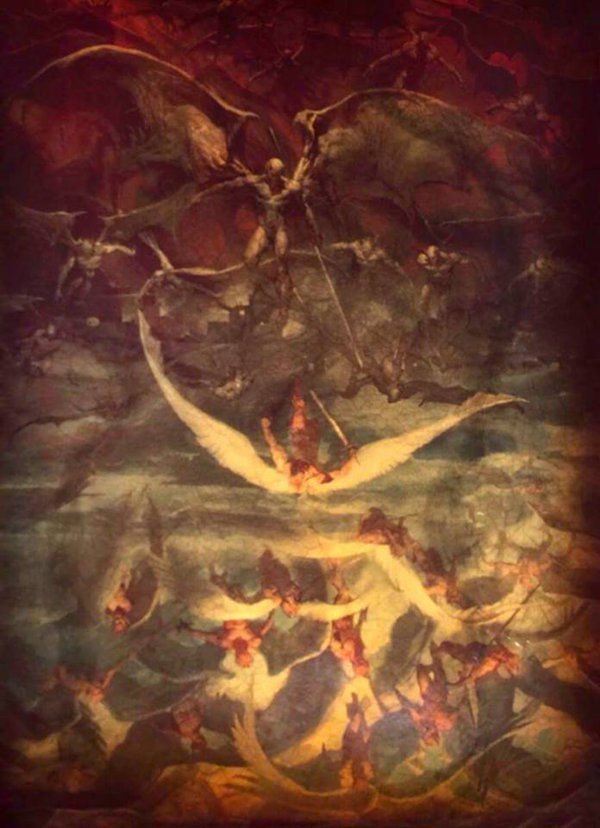
In our postmodern world, we find power to be evil and oppressive; therefore, an all-powerful character such as Superman, or God, must also be evil. Luthor asks Senator Finch, “do you know the oldest lie in America, Senator?” and answers, “it’s that power can be innocent.” Superman cannot be innocent; God cannot be innocent. Lex even goes as far as saying that Superman is a demon. Referring to a painting seen below, he says, “That should be upside down. We know better now, don’t we? Devils don’t come from hell beneath us. No, they come from the sky.”

Another key factor in understanding our culture today comes from one of Zack Snyder’s favorite lines, in which Superman, and traditional morality, is no longer sought after.4 Perry White, the Editor and Chief of the Daily Planet, yells at Clark for writing on the Batman. The dialogue goes as follows:

Perry White: You don’t get to decide what the right thing is.

Clark Kent: When the Planet was founded, it stood for something, Perry.

Perry White: And so could you if it was 1938, but it’s not 1938. WPA ain’t hiring no more. Apples don’t cost a nickel. Not in here, not out there. You drop this thing! Nobody cares about Clark Kent taking on the Batman.

There no longer exists a foundation for morality in today’s age. The age in which Superman was made (1938) no longer exists, hence why Zack Snyder’s Superman carries a dark overtone and is no longer the hopeful, bright, traditional Superman. It is not just Superman that finds himself in another world, but Batman as well.

The Nihilistic Übermensch and Killer of God

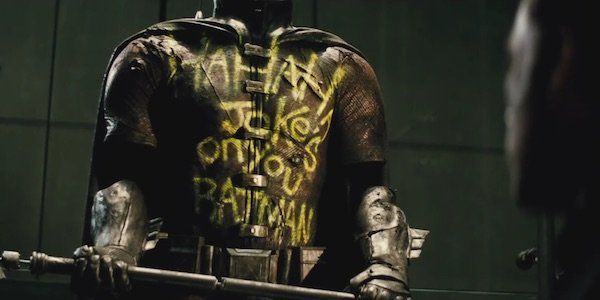
A problem that many fans took with Zack Snyder’s Batman is the fact that Snyder violated Batman’s famous “no-kill” rule. Batman traditionally does not kill; however, Snyder’s Batman kills without hesitation. This is due to the hardened nature of Ben Affleck’s Batman, who is a Nietzsche inspired Übermensch that has gone beyond good and evil. We get a glimpse of why Batman is this way when he stares at what is, presumably, Jason Todd’s Robin suit:

For those that are unaware, Jason Todd was a Robin who was beat to death with a crowbar by the Joker. In the comic book storyline, “A Death in the Family” we see Batman come the closest he ever has been to killing the Joker, yet he does not. Zack Snyder wished to push the Batman character to the edge to explore what Nihilism does to a hero and what the Übermensch is capable of.

Alfred Pennyworth gives us a glimpse into this nihilistic change in Batman when he says, “Oh, yes it has, sir. Everything’s changed. Men fall from the sky, the gods hurl thunderbolts, innocents die. That’s how it starts, sir. The fever, the rage, the feeling of powerlessness that turns good men… cruel.” Bruce Wayne, after the death of Jason Todd, feels powerless; therefore, he must transcend his moral tradition, he must go beyond good and evil, he must forge his own purpose and meaning. We see this most bluntly when Batman is dragging Superman on the ground during their battle and says, “bet your parents taught you that you mean something; that you’re here for a reason. My parents taught me a different lesson; dying in the gutter for no reason at all. They taught me that the world only made sense if you forced it to”. In Nietzsche’s world, Batman must carve out his own meaning to defeat his nihilism.

Sadly, what happens when we forfeit the Christian tradition is the death of God and with it, the character death of our heroes. We get a Batman that kills and that wishes to kill God.

See Part Two for an exploration of Superman as a Christ-figure that redeems Bruce Wayne through the “incarnation” and through his sacrificial death.

  1. https://www.cnn.com/2013/06/14/showbiz/zack-snyder-man-of-steel ↩︎
  2. Ibid. ↩︎
  3. Lactantius, De Ira Dei (On the Wrath of God), 1.13. ↩︎
  4. https://www.hollywoodreporter.com/movies/movie-news/zack-snyder-shares-secrets-lost-batman-v-superman-sequels-1287433/ ↩︎

Comments Off on Batman V Superman (2016) and its Missed Theological Message – Part 1

Superman (2025): Who Do We Want Superman to Be?

Christians should evaluate what kinds of characters we want in media after the loss of yet another Christ figure in Superman (2025).

In the past two articles in this three part series, I’ve argued that in past Superman movies, Superman was written as a Christ figure, or someone who emulates an important aspect or aspects of Christ’s character, mission or identity. For the newest movie, Superman (2025), I’ve made the case that this Superman is not a Christ figure, and is instead more of a humanist or existentialist exemplar.

But, so what? So what if this Superman is more humanist than messianic? For those that enjoyed the movie (and I certainly did too), this whole article might seem like another pointless addition to the never ending culture war. Superman (2025) is supposed to be a fun summer movie that you enjoy for the visuals and don’t think too deeply about. Right?

The truth is, very few (if any) instances of art and media are truly neutral, philosophically speaking. The significant changes to Superman’s origins and character were clearly deliberate. And if deliberate, then they were likely motivated by a philosophical stance or agenda. Our art, including “fun summer movies”, shapes us and forms us as people. The messages in our movies, shows and literature inform and influence our worldviews. So as Christians, we need to be constantly mindful and vigilant of all the implicit messages that any story, even the fun and silly ones, is trying to communicate. 

Christian Existentialism

So what do we do with this new Superman? Must Superman be a Christ figure to be acceptable? First, it must be said that existentialism isn’t an inherently bad philosophy. There were some Christian existentialists, such as Søren Kierkegaard, Blaise Pascal and Fyodor Dostoevsky. They generally upheld the importance of personal choice. Pascal, for example, is famous for “Pascal’s Wager”, which encourages people to believe in God even in the absence of evidence, as rejecting God could have dire consequences. 

And some existentialist views do correspond to Christian teachings. Existentialism teaches that your choices make you what you are. We can find a similar theme in 2 Peter 1:3-11. Here, Peter tells us that though God has “given us everything we need for a godly life”, we are to “make every effort” to complement our faith with various spiritual virtues. These virtues “will keep you from being ineffective and unproductive in your knowledge of our Lord Jesus Christ”. Whoever does not have them is “nearsighted and blind”. So in some sense, we are responsible for the formation of our own character, and it is up to us (though of course with the help of God’s grace) to make the right choices in order to be a virtuous person. 

This means that there are many positive lessons to learn from Superman (2025). Just like Clark, none of us have a choice when it comes to the parents we have, or the situation we are born into. But we can make the right choices despite our origins, as Clark did. No matter how ungodly or godly our household was during our childhoods, for example, it is up to each of us individually to accept God’s free gift of salvation and choose to obey Him. 

Sisyphus or Savior?

On the other hand, Superman has long been a prominent Christ figure (at least in the movies). One less Christ figure in media means even less Christian influence in contemporary entertainment. And Superman (2025) is not alone. Shows like Invincible and The Boys turn “superman” figures into ruthless conquerors or morally bankrupt, egocentric frauds. These shows teach that you can’t trust the Christ figures. Rather, people must abandon hope in salvation from above and embrace the existentialist idea that you can only save yourself. 

Maybe we as Christians don’t want every single character in our media to be just another flawed human being. Maybe we do want Christ figures in our films, shows and literature. At least, we might sometimes want stronger, more explicit Christian themes in our entertainment rather than just generic ethical messages that can apply to any worldview. The less Christ figures we have in our media, the less interested our culture might become in Christ. The more the gospel gets squeezed out of our stories, the more our entertainment becomes the salt that has lost its taste, or the light which is hidden under a basket. 

Maybe Superman doesn’t have to be messianic for us to enjoy him. But surely we want some character out there to remind us of Christ. 

Comments Off on Superman (2025): Who Do We Want Superman to Be?

Type on the field below and hit Enter/Return to search