Batman V Superman (2016) and its Missed Theological Message – Part 1

Bad Movie or Missed Message? Batman V Superman, while far from perfect, is an amazing film. However, back in 2016, my friends and I, as well as most of the…

Bad Movie or Missed Message?

Batman V Superman, while far from perfect, is an amazing film. However, back in 2016, my friends and I, as well as most of the world, did not think so. Everyone who saw the film can remember the hilarious memes:

However, since then, I have grasped the theological significance of the movie and believe that Batman V Superman is an underappreciated, underrated, and over hated movie that has a deep theological message that went over the heads of the general audience. This, I think, is due to the theological apathy and biblical illiteracy of our current culture. While Zack Snyder, the director, is well known for his religious imagery in his films, one first must ask if it was Zack Snyder’s intention to make a theologically motivated film. In an interview with CNN, he says:

When we started to examine the Superman mythology, in the most classic sense, I really wanted to press upon the film the ‘why’ of him, which has been 75 years in the making… The Christ-like parallels, I didn’t make that stuff up. We weren’t like, ‘Hey, let’s add this!’ That stuff is there, in the mythology. That is the tried-and-true Superman metaphor. So rather than be snarky and say that doesn’t exist, we thought it would be fun to allow that mythology to be woven through.1

Snyder also posits one of the main questions of the film: “At 75, is Superman still our hero?”2 Zack Snyder builds upon this question by diving into the Problem of Evil, examining our culture’s attitude towards Christianity, by framing Superman as a Christ-figure, and by creating an amazing character arch for Ben Affleck’s Batman.

The Problem of Evil

Lex Luthor, when confronting Superman, exclaims, “See, what we call God depends upon our tribe, Clark Jo, cause God is tribal. God takes sides. No man in the sky intervened when I was a boy to deliver me from Daddy’s fist and abominations. I figured out way back if God is all-powerful, He cannot be all good. And if He is all good, then He cannot be all-powerful. And neither can you be.”

Lex Luthor takes directly from Epicurus’ famous argument: “Is God willing to prevent evil, but not able? Then he is not omnipotent. Is he able, but not willing? Then he is malevolent. Is he both able and willing? Then whence cometh evil? Is he neither able nor willing? Then why call him God?”3

It is not just villains who ask these questions, but biblical authors as well. David writes, “how long, Lord? Will you forget me forever? How long will you hide your face from me?” (Ps. 13:1). The prophet Habakkuk asks, “how long, Lord, must I call for help, but you do not listen? Or cry out to you, ‘Violence!’ but you do not save? Why do you make me look at injustice? Why do you tolerate wrongdoing?” (Hab. 1:2-3)

It is of great importance to notice that it is okay and even good to ask the questions that Luthor has; however, they do not demand hatred for God nor the logical conclusion that God does not exist. In fact, philosophers distinguish between the logical problem of evil and the evidential problem of evil because the former, the “Lex-Lutherian” form, fails, since it does not logically follow that God does not exist because evil exists. While there are many, many answers to the Problem of Evil, one answer explored by Zack Snyder is the Incarnation. But before we get to that, we must first analyze the current culture.

Christianity as Evil and Outdated

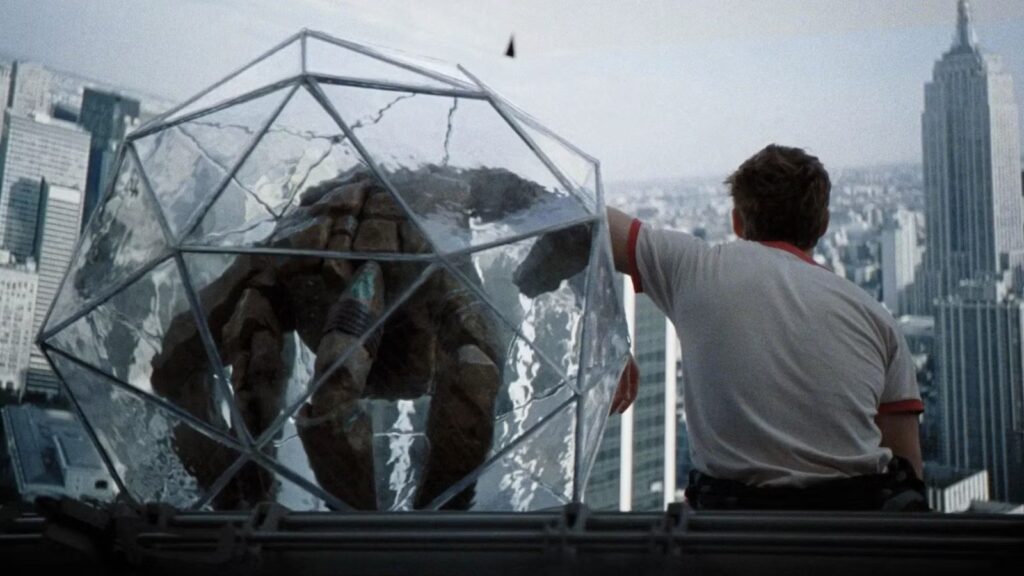
In our postmodern world, we find power to be evil and oppressive; therefore, an all-powerful character such as Superman, or God, must also be evil. Luthor asks Senator Finch, “do you know the oldest lie in America, Senator?” and answers, “it’s that power can be innocent.” Superman cannot be innocent; God cannot be innocent. Lex even goes as far as saying that Superman is a demon. Referring to a painting seen below, he says, “That should be upside down. We know better now, don’t we? Devils don’t come from hell beneath us. No, they come from the sky.”

Another key factor in understanding our culture today comes from one of Zack Snyder’s favorite lines, in which Superman, and traditional morality, is no longer sought after.4 Perry White, the Editor and Chief of the Daily Planet, yells at Clark for writing on the Batman. The dialogue goes as follows:

Perry White: You don’t get to decide what the right thing is.

Clark Kent: When the Planet was founded, it stood for something, Perry.

Perry White: And so could you if it was 1938, but it’s not 1938. WPA ain’t hiring no more. Apples don’t cost a nickel. Not in here, not out there. You drop this thing! Nobody cares about Clark Kent taking on the Batman.

There no longer exists a foundation for morality in today’s age. The age in which Superman was made (1938) no longer exists, hence why Zack Snyder’s Superman carries a dark overtone and is no longer the hopeful, bright, traditional Superman. It is not just Superman that finds himself in another world, but Batman as well.

The Nihilistic Übermensch and Killer of God

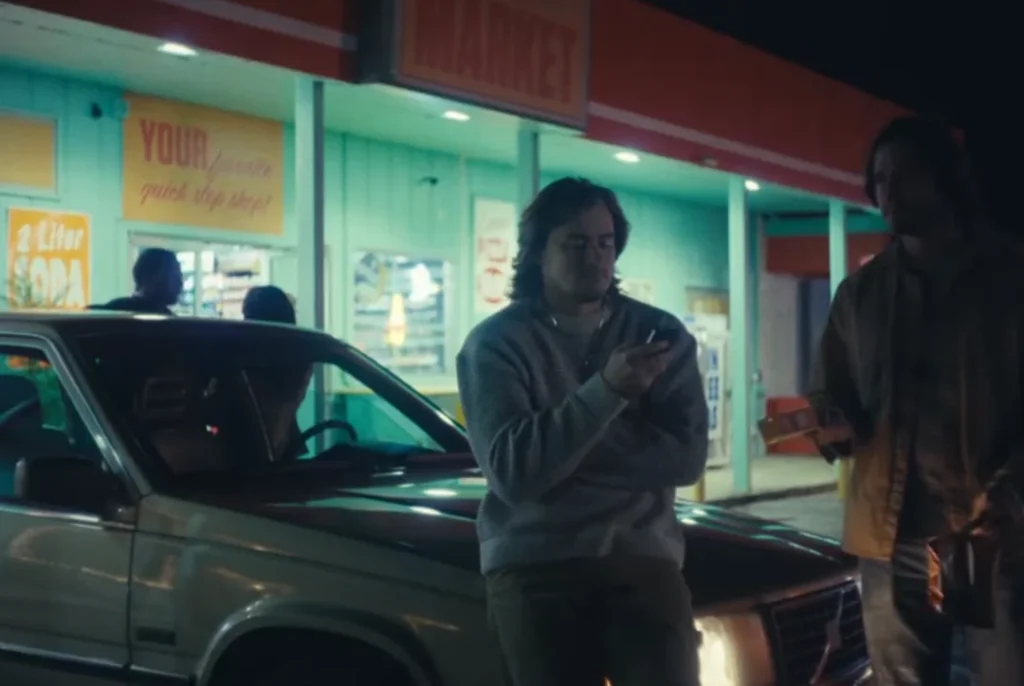
A problem that many fans took with Zack Snyder’s Batman is the fact that Snyder violated Batman’s famous “no-kill” rule. Batman traditionally does not kill; however, Snyder’s Batman kills without hesitation. This is due to the hardened nature of Ben Affleck’s Batman, who is a Nietzsche inspired Übermensch that has gone beyond good and evil. We get a glimpse of why Batman is this way when he stares at what is, presumably, Jason Todd’s Robin suit:

For those that are unaware, Jason Todd was a Robin who was beat to death with a crowbar by the Joker. In the comic book storyline, “A Death in the Family” we see Batman come the closest he ever has been to killing the Joker, yet he does not. Zack Snyder wished to push the Batman character to the edge to explore what Nihilism does to a hero and what the Übermensch is capable of.

Alfred Pennyworth gives us a glimpse into this nihilistic change in Batman when he says, “Oh, yes it has, sir. Everything’s changed. Men fall from the sky, the gods hurl thunderbolts, innocents die. That’s how it starts, sir. The fever, the rage, the feeling of powerlessness that turns good men… cruel.” Bruce Wayne, after the death of Jason Todd, feels powerless; therefore, he must transcend his moral tradition, he must go beyond good and evil, he must forge his own purpose and meaning. We see this most bluntly when Batman is dragging Superman on the ground during their battle and says, “bet your parents taught you that you mean something; that you’re here for a reason. My parents taught me a different lesson; dying in the gutter for no reason at all. They taught me that the world only made sense if you forced it to”. In Nietzsche’s world, Batman must carve out his own meaning to defeat his nihilism.

Sadly, what happens when we forfeit the Christian tradition is the death of God and with it, the character death of our heroes. We get a Batman that kills and that wishes to kill God.

See Part Two for an exploration of Superman as a Christ-figure that redeems Bruce Wayne through the “incarnation” and through his sacrificial death.

  1. https://www.cnn.com/2013/06/14/showbiz/zack-snyder-man-of-steel ↩︎
  2. Ibid. ↩︎
  3. Lactantius, De Ira Dei (On the Wrath of God), 1.13. ↩︎
  4. https://www.hollywoodreporter.com/movies/movie-news/zack-snyder-shares-secrets-lost-batman-v-superman-sequels-1287433/ ↩︎

No Comments on Batman V Superman (2016) and its Missed Theological Message – Part 1

NF, Mental Health, and Christian Culture

I, as a fan of NF, was excited for his EP FEAR (2025) that was released a couple of weeks ago; however, I was surprised by its content. NF has…

I, as a fan of NF, was excited for his EP FEAR (2025) that was released a couple of weeks ago; however, I was surprised by its content. NF has always struggled with his mental health, but in his album HOPE (2023), he portrayed himself as overcoming fear. He had found a map to hope, he had finally forgiven his mom in his song “MAMA” (something he could not do in his song “How Could You Leave Us”), and he portrayed himself as joyful and content within his career in the song “MOTTO”. Most importantly he had finally outrun his depression and fear in his song “RUNNING”:

I wish you well, but I can no longer stand aside
And watch you sabotage the two of us
I love you to death, but I can’t spend the rest of my
Life in this darkness, I’m done
I’m done1

To fully understand the significance of NF’s newest EP, we should go back to the beginning. Before he was under the name NF, he had made a Christian rap album titled Moments (2010) under his actual name Nathan Feuerstein. Once he was under the name NF, he stopped being a “Christian rapper” but still leaves traces of his faith throughout all his music. In his song “Mansion” he opened up about the abuse that he faced at the hands of his mother’s boyfriend, discusses his mother’s death, and discusses his loneliness. He also portrays his mind as a mansion, and it is here where fear is introduced into his discography:

Fear came to my house years ago, I let him in
Maybe that’s the problem, ’cause I’ve been dealing with this ever since
I thought that he would leave, but it’s obvious he never did
He must have picked the room and got comfortable and settled in
Now I’m in the position, it’s either sit here and let him win
Or put him back outside where he came from, but I never can
‘Cause in order to do that I’d have to open the doors
Is that me or the fear talking?
I don’t know anymore1

He then went on to compose the song “Therapy Session” where he discusses how music is a gift from God. He says:

Like, this is something that personally helps me as well
I’m not confused about who gave me the gift
God gave me the gift and He gave me the ability to, to do this
And He also gave me this as an outlet
And that’s what music is for me2

NF’s music serves as an outlet for his struggles and even functions as a way to relate to God. In his album Perception (2017), we got a taste of hope for NF as he buried fear in his song “Intro 3”. It is also here where he introduced the keys that reappear throughout his music. In his album The Search (2019), he started the journey of finding hope. In The Search we got hopeful songs such as “Change” and “The Search”, but we also got vulnerable and despairful songs such as “Trauma”, “Hate Myself”, and “Let Me Go”. In the album HOPE, which is mentioned above, he began to produce more positive songs.

In his newest song “FEAR” we learn that fear has been unburied, that NF is struggling again with his OCD, and that NF has relapsed. Referring to the song “RUNNING” he says:

Told the world that I was sick of runnin’, then went back to runnin’, what a joke
Disappointed, yeah, me too, I thought I finally had finally made a breakthrough, guess not3

The Chorus then begins a discussion with God:

Standing back, watching my mansion burn to ash while I
Hold the gas can, asking God if He started this fire
Is this what You wanted? Is this what You wanted?4

NF poses a great question, does God cause the burning of some of our “mansions”? I think sometimes yes. C.S. Lewis thought that his grief over his wife’s death was an opportunity for God to knock down his “mansion”. Lewis writes, “He always knew that my temple was a house of cards. His only way of making me realize the fact was to knock it down.”5 The Apostle James writes, “Consider it pure joy, my brothers and sisters, whenever you face trials of many kinds, because you know that the testing of your faith produces perseverance” (James 1:2-3). While James is writing to persecuted Christians, I do think this passage can be applied for all kinds of trials. I think NF even realizes in his song “WASHED UP” that God is at work within his trials:

The Lord knew I needed this to survive the violence
The raw truth, I’m nothin’ without the Father’s guidance6

The “this” he needed to survive the violence is music, and he realizes that without the father’s guidance and gift of music, he would be nothing. One could even say that music is an instrumental cause or tool of sanctification for NF. If he is guided by the Father and the Father is the one who “started the fire” then could the burning of the mansion be something good? Could the burning of the mansion be an act of conforming one’s mind to a new foundation as the Apostle Paul tells us to do? In the music video for “HOPE”, NF, as the hope character, is outside of the mansion but gets pushed back into the mansion by fear. In “Mansion” NF wanted the mansion to be burned down:

Wish I could take a match and burn this whole room to the ground
Matter of fact, I think I’ma burn this room right now
So how this memory for some reason just won’t come down7

In the music video for “WASHED UP” it is not fear who burns the mansion; it is a new grim reaper character. Some fans have theorized this is NF’s anger, death itself, or simply NF. In “FEAR” it is hope who holds the gas can. Who is burning the mansion? Is it God, NF, hope, death, or anger? NF also repeatedly asks if this is what God wants:

Make all my hopes and my dreams come to life just to lay them to rest
Is this what You wanted? Is this what You wanted?
Give me a false sense of peace just to show me what peace really is
Is this what You wanted?8

What is this false sense of peace? I think he provides room for speculation as he ends “WASHED UP” with asking:

Am I on the brink of somethin’ great
Or have I lost it?
Am I on the verge of makin’ waves
Or am I washed up?9

It seems that NF no longer has peace due to his worry that he is washed up. Is NF’s peace in his career or is it in Christ? Ultimately, these questions that I propose will not be answered by me, so I leave them for NF to hopefully answer them in an upcoming album. But I do wish to make two key points about NF’s struggles.

Christian Culture’s Need For REALNESS

Even if NF’s peace is in Christ, that does not mean that he should not be relapsing. Growing up as an NF fan, I remember that some people thought that Christians should not listen to NF due to his music being too depressing. However, his authenticity, honesty, and vulnerability ought to help Christians. One third of the Psalms, which are music, are laments. We find many Psalms such as Psalms 3, 13, 22, 42, and 44 comforting even though they can be perceived as depressing. Psalm 88 is one of the most depressing as it ends with the author saying that darkness is his only friend. Ecclesiastes is known for its depressing character; however, it too is therapeutic. Jesus Himself is authentic and does not hide his emotions from God. Fulfilling Psalm 22 He asks, “my God, My God, why have you forsaken me?” (Matthew 27:46). The church, as the body of Christ, needs this authenticity and vulnerability!

I think a key aspect to NF’s success is his authenticity and vulnerability; he is REAL and people desire realness. Sadly, the church is not perceived as REAL. A 2024 study found that only 52% of individuals say that they think their church community has no stigma when it comes to mental health.10 This stigma is so prevalent within the church that NF left the Christian music industry because he felt his music did not fit the Christian mold.11 We often have a fear of how we are perceived within our church communities. If one admits that he is struggling, then he may wonder if his church community will shun him. However, David, a man after God’s own heart, never shied away from his struggles; his struggles even became a means of worship for Israel!

We must ask and discuss if the church makes room for questions, doubts, confessions, relapses, mental health, and thematically dark art as God gave us such artistic expressions as a therapeutic outlet. The church ought to be REAL and if the church cultivates this, then we can help those who are relapsing, who are struggling to overcome sin, who struggle with mental health, and who are wrestling with God. We need this because we all fit those descriptions; the question is, are we willing to be vulnerable enough to admit it and discuss it?

  1. NF, featuring Fleurie. “Mansion.” On Mansion, 2015, Capitol CMG, audio. ↩︎
  2. NF. “Therapy Session.” On Therapy Session, track 1, Capitol Christian Music Group, 2016, audio. ↩︎
  3. NF. “FEAR.” On FEAR, NF Real Music, LLC, 2025, audio.  ↩︎
  4. Ibid.  ↩︎
  5. Lewis, C.S. A Grief Observed, New York: HarperCollins, 1961. ↩︎
  6. NF. “WASHED UP.” On FEAR, NF Real Music, LLC, 2025, audio. ↩︎
  7. NF, featuring Fleurie. “Mansion.” On Mansion, 2015, Capitol CMG, audio. ↩︎
  8. NF. “FEAR.” On FEAR, NF Real Music, LLC, 2025, audio.   ↩︎
  9. NF. “WASHED UP.” On FEAR, NF Real Music, LLC, 2025, audio. ↩︎
  10. “New Polling Data Shows Most People of Faith Would Seek Mental Health Care if Recommended by Their Faith Leader”, American Psychiatric Association, September 16, 2024, https://www.psychiatry.org/news-room/news-releases/new-polling-data-shows-most-people-of-faith-would#:~:text=WASHINGTON%2C%20D.C.%20%E2%80%94%20A%20survey%20released,condition%2C%E2%80%9D%20said%20Marketa%20M. ↩︎
  11. Justin Sharachik, “NF Gives Definitive Answers on His Faith & Christian Rap Roots”, May 13, 2023, https://rapzilla.com/2023-05-nf-gives-definitive-answers-faith-christian-rap-roots/. ↩︎
1 Comment on NF, Mental Health, and Christian Culture

On Superheroes

Spare our Lord Jesus Christ, I sometimes believe that there are no real superheroes, that there is not one benevolent person who possesses superhuman powers. Despite sometimes not believing in…

Spare our Lord Jesus Christ, I sometimes believe that there are no real superheroes, that there is not one benevolent person who possesses superhuman powers. Despite sometimes not believing in them, I am uplifted by fictitious stories of superheroes. Amidst chaos, a little boy closes his eyes and says, “Superman,” and the enthused faith with which he anticipates the hero’s coming is as sure as the noon sun on a clear day.

Contemporary man, I think, believes superheroes are fiction, where fictions lack concrete existence. To be sure, there is a sense in which he should. Clark Kent qua person does not exist; there is no person who is Clark Kent. Nevertheless, the fascination with which man entertains fictitious superheroes is not unusual, for he was designed to delight in superheroes. It is a natural inclination of man to take satisfaction in characters who make the ordinary unfamiliar and surprising. Superheroes excite and imbue the imagination with wonder and hope.

Yet the Creator’s intention, I think, was not that I should satisfy my desire for superheroes with merely fictitious narratives. Primarily satisfying the yearning for superheroes through fiction is, in many respects, primarily delighting in novelties, characters with no concrete correspondence to reality. When contemporary man satisfies himself in this way, the fictitious superheroes largely replace the reality of God’s blessings to man. Fictitious superheroes are for the a-religious what the saints of God are to the Christian. A cursory glance at hagiographical and Scriptural texts attests to parallels between fictional superheroes and saints:

By God’s blessing, St. Scholastica caused a storm to erupt, ensuring she could spend more time with her brother (Abbey, 239). St. Padre Pio could multiply locate (bilocate) his physical body (Mróz, 135). St. Saraphim of Sarov befriended a bear who placidly fetched him honey (Cavarnos and Zeldin, 65). St. Clare of Assisi struck terror into the hearts of advancing Roman soldiers simply by raising a pyx (Abbey, 64). Mary, the Mother of God, caused the sun to sway in the sky (Dalleur). St. Joseph of Cupertino levitated before astonished parishioners (Herbermann, 520). St. Elijah the Prophet caused fire to descend from the heavens (1 Kings 18:38). St. Michael the Archangel banished Satan from Paradise in a flash of lightning (Luke 10:18).

Throughout history, there have been thousands of saints whose lives demonstrate benevolence and superhuman powers. Despite this astounding fact, it is more common for children to want to be like Spider-Man than any one of these. This should perturb any Christian. The reality is that Spider-Man doesn’t exist, and many children are unaware of God’s blessings to man because of their parents’ ignorance or negligence, and because of society’s fictional infatuations. Contemporary man, I think, falsely infers the non-existence of real superheroes from the fact of the non-existence of fictitious superheroes: Superman, Captain America, Batman, the Hulk, etc., don’t exist. Therefore, superheroes don’t exist. This inference is partly due to a lack of knowledge or interest concerning the lives of the saints, the highest constituents of God’s heavenly city–the real superheroes.

Let not your attention nor desire for the wonderful be consumed by these pseudo-religious films depicting fictional superheroes. I don’t claim there’s something wrong per se with taking delight in novelties, but there is something wrong with delighting in them more frequently than in our beloved saints. Mary Oliver has a similar reflection when wading through the beauty of God’s creation: “Something is wrong, I know it, if I don’t keep my attention on eternity…May I forever stay in the stream (7).” Even if there is nothing wrong with delighting in novelties per se, they should always, nevertheless, be understood in light of reality. But I’m afraid that contemporary man is more familiar with fictional tales than with the reality of God’s providence. For that reason (among many others), together with his faulty inference, contemporary man, I think, believes superheroes are fiction.

Possible Discussion Questions

Would delighting in any fictional story entail delighting in a novelty, a fad for reality? What if what one finds delightful in a “novelty” are the symbols with which the fictional story allegorizes reality? Is delighting in allegories equivalent to delighting in fads? Is it bad to know more about Gandalf than the “highest constituents” of God’s heavenly city? Are fictional tales and God’s providence mutually exclusive?

Bibliography

  • Cavarnos, Constantine and Zeldin, Mary-Barbara. Modern Orthodox Saints, St Seraphim of Sarov, 10 vols. The Institute for Byzantine and Modern Greek Studies, 2001.
  • Dalleur, Philippe. “Fatima Pictures and Testimonials: in-depth Analysis.” Scientia et Fides 9, no. 1 (2021): 9-45.
  • Herbermann, Charles et al. The Catholic Encyclopedia, vol. 8, 15 vols. The Encyclopedia Press. 1915.
  • Mróz, Franciszek. “On the Footprings of Saint Padre Pio of Pietrelcina.” Peregrinus Cracoviensis 13. (2002): 135-157.
  • Oliver, Mary. Upstream: Selected Essays. Penguin Books, 2016.
  • St. Augustine’s Abbey, The Book of Saints. A&C Black, 1921.
No Comments on On Superheroes

Superman (2025): Who Do We Want Superman to Be?

In the past two articles in this three part series, I’ve argued that in past Superman movies, Superman was written as a Christ figure, or someone who emulates an important…

In the past two articles in this three part series, I’ve argued that in past Superman movies, Superman was written as a Christ figure, or someone who emulates an important aspect or aspects of Christ’s character, mission or identity. For the newest movie, Superman (2025), I’ve made the case that this Superman is not a Christ figure, and is instead more of a humanist or existentialist exemplar.

But, so what? So what if this Superman is more humanist than messianic? For those that enjoyed the movie (and I certainly did too), this whole article might seem like another pointless addition to the never ending culture war. Superman (2025) is supposed to be a fun summer movie that you enjoy for the visuals and don’t think too deeply about. Right?

The truth is, very few (if any) instances of art and media are truly neutral, philosophically speaking. The significant changes to Superman’s origins and character were clearly deliberate. And if deliberate, then they were likely motivated by a philosophical stance or agenda. Our art, including “fun summer movies”, shapes us and forms us as people. The messages in our movies, shows and literature inform and influence our worldviews. So as Christians, we need to be constantly mindful and vigilant of all the implicit messages that any story, even the fun and silly ones, is trying to communicate. 

Christian Existentialism

So what do we do with this new Superman? Must Superman be a Christ figure to be acceptable? First, it must be said that existentialism isn’t an inherently bad philosophy. There were some Christian existentialists, such as Søren Kierkegaard, Blaise Pascal and Fyodor Dostoevsky. They generally upheld the importance of personal choice. Pascal, for example, is famous for “Pascal’s Wager”, which encourages people to believe in God even in the absence of evidence, as rejecting God could have dire consequences. 

And some existentialist views do correspond to Christian teachings. Existentialism teaches that your choices make you what you are. We can find a similar theme in 2 Peter 1:3-11. Here, Peter tells us that though God has “given us everything we need for a godly life”, we are to “make every effort” to complement our faith with various spiritual virtues. These virtues “will keep you from being ineffective and unproductive in your knowledge of our Lord Jesus Christ”. Whoever does not have them is “nearsighted and blind”. So in some sense, we are responsible for the formation of our own character, and it is up to us (though of course with the help of God’s grace) to make the right choices in order to be a virtuous person. 

This means that there are many positive lessons to learn from Superman (2025). Just like Clark, none of us have a choice when it comes to the parents we have, or the situation we are born into. But we can make the right choices despite our origins, as Clark did. No matter how ungodly or godly our household was during our childhoods, for example, it is up to each of us individually to accept God’s free gift of salvation and choose to obey Him. 

Sisyphus or Savior?

On the other hand, Superman has long been a prominent Christ figure (at least in the movies). One less Christ figure in media means even less Christian influence in contemporary entertainment. And Superman (2025) is not alone. Shows like Invincible and The Boys turn “superman” figures into ruthless conquerors or morally bankrupt, egocentric frauds. These shows teach that you can’t trust the Christ figures. Rather, people must abandon hope in salvation from above and embrace the existentialist idea that you can only save yourself. 

Maybe we as Christians don’t want every single character in our media to be just another flawed human being. Maybe we do want Christ figures in our films, shows and literature. At least, we might sometimes want stronger, more explicit Christian themes in our entertainment rather than just generic ethical messages that can apply to any worldview. The less Christ figures we have in our media, the less interested our culture might become in Christ. The more the gospel gets squeezed out of our stories, the more our entertainment becomes the salt that has lost its taste, or the light which is hidden under a basket. 

Maybe Superman doesn’t have to be messianic for us to enjoy him. But surely we want some character out there to remind us of Christ. 

Comments Off on Superman (2025): Who Do We Want Superman to Be?

Superman (2025): Who is Superman Now?

In the last article, we saw that Christian theology heavily influenced Superman’s origin story and character in past movies. Superman’s benevolent parents send him to guide humanity and be a…

In the last article, we saw that Christian theology heavily influenced Superman’s origin story and character in past movies. Superman’s benevolent parents send him to guide humanity and be a “light” to them. 

Superman (2025) turns this Christian message on its head. At first, it seems as though Clark’s Kryptonian parents are exactly like the Jor-El and Lara (Superman’s mother) of past portrayals. In the Fortress of Solitude, Superman’s Arctic base, Clark listens to a message from his parents. This message definitely seems messianic. Lara explains, “we have searched the universe for a home where you can do the most good and live out Krypton’s truth.” Jor-El then says, “that place is Earth”. Unfortunately, the message is damaged and only a portion of it can be played. 

So far, so good, right? Well, it turns out that Superman’s parents didn’t really have the best intentions in mind for Earth. Superman’s nemesis Lex Luthor later exposes the missing portion of Jor-El and Lara’s message, revealing a sinister, imperialist plot. 

Jor-El tells his son, “The people there (Earth) are simple and profoundly confused, weak of mind and spirit and body.” So Jor-El commands Superman to “lord over the planet as the last son of Krypton” and to “rule without mercy”. Lara twists the knife with this spectacular advice: “Dispatch of anyone unable or unwilling to serve you, Kal-El. Take as many wives as you can so your genes and Krypton’s might and legacy will live on in this new frontier.”  

Message Denied

Obviously, Clark and the denizens of Earth don’t receive this message so well. So, a distraught Clark turns to his adoptive human father, Jonathan Kent, for advice. Jonathan, in a tenderhearted tone that reflects his down-to-earth wisdom, tells his son that “parents aren’t for telling their children who they’re supposed to be”. 

We can already see how Superman (2025) changes Clark’s Christian origins somewhat radically. Instead of godlike, benevolent parental figures, Clark’s Kryptonian parents are chauvinistic and authoritarian. Clark’s messianic mission is nothing more than an imperialist plot. And we learn that not only should Clark’s biological parents be rejected as moral guides, but actually no parent should tell their children who they’re supposed to be (including divine parents?). It’s not hard to see how these are all significant departures from the Superman of previous films. 

Superman turns more humanist as Jonathan Kent reveals more of his philosophy of identity. Jonathan says, “Your choices, Clark. Your actions. That’s what makes you who you are.”

Sartre’s Superman

Students of existentialism will recognize this message very quickly. It is the classic existentialist motto, “existence precedes essence”. Existentialists such as Jean-Paul Sartre taught that the fact that you exist (existence) comes before facts about what you are (essence). In other words, you start off in the world as an existing thing, but we have no idea what kind of thing or person you are. Why? Because it is your own choices that define what or who you are. Until you start making your own choices and defining who you are for yourself, you are a blank slate, and your essence is indeterminate. 

In his book Existentialism is a Humanism, Sartre explains his philosophy in detail. He writes, “What do we mean by saying that existence precedes essence? (…) If man as the existentialist sees him is not definable, it is because to begin with he is nothing. He will not be anything until later, and then he will be what he makes of himself”.

This view sharply diverges from traditional philosophy, which holds that essence precedes existence. For example, there is such a thing as a universal “human nature” which human beings participate in or take on when they are conceived. But Sartre writes, “there is no human nature, because there is no God to have a conception of it”. Beyond rejecting traditional philosophy, this statement illuminates the atheistic element of Sartre’s existentialism. It also closely relates to Superman’s origins in Superman (2025). 

Kryptonian Enlightenment

As we saw, in stark contrast to the previous Superman films, Superman does not have benevolent, quasi-divine parents to define his identity and mission for him. His parents, like all forms of “organized religion”, turn out to be moral frauds, and Clark must cast their teachings aside. Since he has no guide (like Sartre has no God), Clark must figure out the meaning of life for himself.

As Clark himself declares to his nemesis Lex Luthor at the climax of the movie, “I’m as human as anyone. I love, I get scared. I wake up every morning, and despite not knowing what to do, I put one foot in front of the other, and I try to make the best choices I can. I screw up all the time. But that is being human. And that’s my greatest strength.” 

Maybe nobody created Superman’s new origin story with an anti-religion or anti-theist agenda. But it’s still telling that Superman (2025) not only replaces Superman’s Christian origins and mission, but conspicuously and intentionally subverts them. 

Comments Off on Superman (2025): Who is Superman Now?

Superman (2025): Who Did Superman Used to Be? 

In the newest movie, Superman is much less of a Christ figure and much more of an existentialist hero. Whether or not this change is welcome will depend on what kind of character we want Superman to be. I’ll explore all these questions in a three part article series, beginning with the theme of Superman as a Christ figure in past Superman films. 

Do we want a Christlike Superman or a humanist Superman? The (relatively) new movie Superman (2025) depicts Superman in a way that challenges previous film portrayals of this classic superhero, such as the movies Superman (1978) and Man of Steel. Underneath the colorfully diverse cast of comic book characters, and the bright and chaotic superpowered fights, there are interesting questions to be explored in light of this film’s reinterpretation of Superman’s character, origins and philosophical significance. 

In the newest movie, Superman is much less of a Christ figure and much more of an existentialist hero. Whether or not this change is welcome will depend on what kind of character we want Superman to be. I’ll explore all these questions in a three part article series, beginning with the theme of Superman as a Christ figure in past Superman films. 

The Ghost of Superman Past

Should we think of Superman as a Christ figure? By “Christ figure”, I mean a person who embodies or represents some important aspect (or aspects) of Jesus Christ’s messianic character, identity and/or mission. For example, C.S. Lewis’s character Aslan in The Chronicles of Narnia is a very clear example of a Christ figure. Aslan sacrifices himself to save Edmund’s life, and then later resurrects from the dead. 

So, is Superman like Aslan? Does Superman resemble Christ in any significant way? In old film portrayals of Superman, I think the answer to this question is a definite “yes”. In the newest rendition of Superman, or the movie Superman (2025), I think the answer to this question is “not really”. Again, in this film, the theme is way more humanist than it is Christian. But before we can explore this thematic subversion, and why it matters, we must travel back in time to see how older films depicted Superman as a Christ figure. 

It is not hard to see the Christian elements of Superman in films like Man of Steel and especially Superman (1978). The character of Superman naturally has messianic undertones, as he is a godlike being who can fly, is nigh invulnerable, and who has all sorts of other overpowered abilities like super strength, super speed, and heat vision. He also spends his free time flying around Metropolis saving people. If that wasn’t enough, his typical origin story is that his parents sent him from the dying planet Krypton to Earth to guide humanity and give them hope. This sounds a lot like what a divine Messiah might do.


Man of Steel and the Messiah

Take Man of Steel, for example. In this movie, Clark Kent (his Kryptonian name is Kal-El) boards a Kryptonian ship in the Arctic and talks to Jor-El, his Kryptonian father, who is now just an Artificial Intelligence aboard the ship. 

“The people of earth are different from us, it’s true. But ultimately I believe that’s a good thing,” Jor-El says. “They won’t necessarily make the same mistakes we did. Not if you guide them, Kal. Not if you give them hope.” 

Jor-El explains that the “S” symbol, Superman’s symbol, means “hope”. He says, “Embodied within that hope is the fundamental belief in the potential of every person to be a force for good. That’s what you can bring them.” 

So here, Superman is meant to give humans guidance and hope. Specifically, he’s tasked by his father to carry out this spiritual mission. Jor-El tells his son, “You’re as much a child of Earth now as you are of Krypton. You can embody the best of both worlds.”

Sound familiar? John 1:14 declares “And the Word became flesh and dwelt among us, and we have seen his glory, glory as of the only Son from the Father, full of grace and truth”. And Philippians 2:6-7 says that Jesus “though he was in the form of God, did not count equality with God a thing to be grasped, but emptied himself, by taking the form of a servant, being born in the likeness of men.”

So just as Clark is Kryptonian, yet can also identify with humanity, Jesus is fully divine and fully human. 

The Savior in Superman (1978)

Superman (1978) presents Superman as even more of a Christ figure. In this movie, Jor-El tells Clark, “It is now time for you to rejoin your new world and to serve its collective humanity…They can be a great people, Kal-El, they wish to be. They only lack the light to show the way. For this reason above all, their capacity for good, I have sent them you, my only son.”

Two of Jor-El’s terms here are conspicuously Christian. First, Clark is to be a “light to show the way”. In John 8:12, Jesus says, “I am the light of the world. Whoever follows me will never walk in darkness, but will have the light of life.” Second, Jor-El sends his “only son” to be this light for humanity. This echoes John 3:16:  “For God so loved the world that he gave his one and only Son, that whoever believes in him shall not perish but have eternal life.”

Back to the Future

All in all, it seems pretty clear that past portrayals of Superman in film have presented him as a Messianic, Christlike figure who is sent to Earth by his father Jor-El (a parallel of God the Father) to guide and save humanity. 

But as we’ll see, this is not at all how Superman’s origins play out in Superman (2025). In this movie, Superman’s parents are a lot more like Nazis than they are like God the Father, and the mission they give Superman is malevolent, not messianic. This revision of Superman’s origin story fundamentally changes Superman’s philosophical and religious significance.

Comments Off on Superman (2025): Who Did Superman Used to Be? 

You might also like...

Romance and Representation: A Review of Crazy Rich Asians

Type on the field below and hit Enter/Return to search