
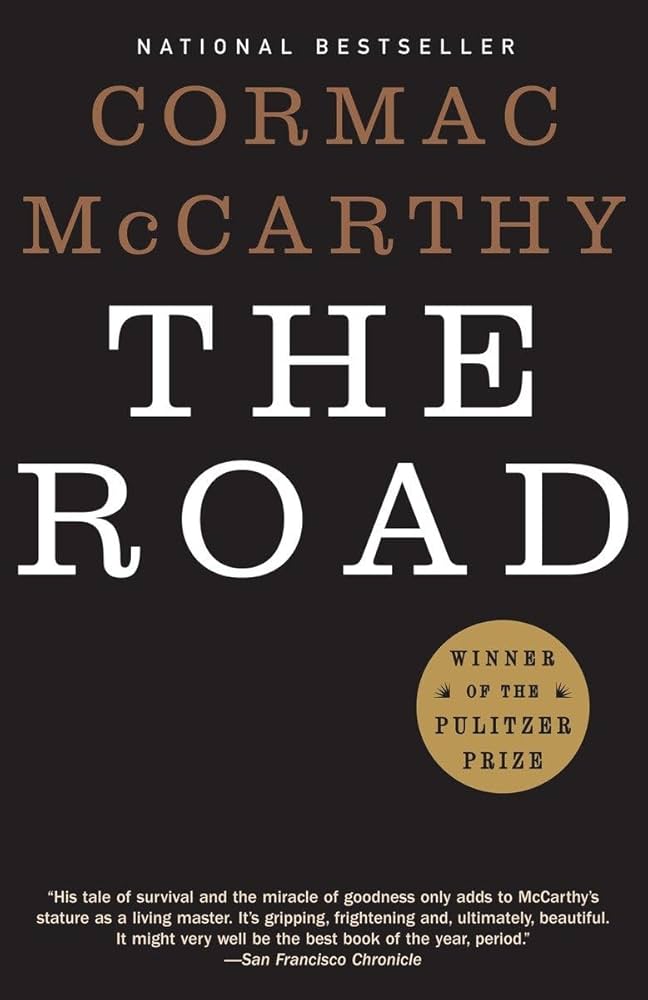
Cormac McCarthy’s apocalyptic novel The Road offers three distinct responses to the question of whether or not life is worth living.
What do you think of existential questions like “what is the meaning of life”, and “why are we here”, and “is life worth living”? Does it matter to you what the answers are? Or are they nothing more to you than abstract intellectual questions, trapped (and thankfully so) in the isolated classrooms of higher ed?
In Cormac McCarthy’s somber novel The Road, our characters are forced to confront these questions every time they wake up in the morning. In the aftermath of an apocalypse, the land is barren, ashen, and cold, and for our protagonists, a father and his son, each day is a desperate struggle to scrounge for food. On top of this, the land is crawling with cannibals who would not hesitate to murder and eat both the father and his son. So, what’s the point of continuing this miserable and unremitting struggle?
In this novel, McCarthy seems to write his characters according to three distinct archetypes: the wanderer, the nihilist, and the existentialist. These archetypes represent different ways of responding to the problem of meaning. The wanderer lacks any type of definitive purpose for living. The nihilist accepts that life is hopeless and sees death as the only way out. The existentialist, on the other hand, refuses to give in to despair and instead rebels: although life may have no objective purpose, the existentialist invents a reason to live. We will see how these three responses fare in the unforgiving landscape of The Road.
Slogging Along
We only get into the heads of a small number of characters in The Road, but it’s safe to say that most of the people left in this world are wanderers. They continue to try to survive, but they lack any type of goal or reason for persisting in life.
The cannibalistic gangs are a great example of this. They seem to have completely abandoned any semblance of humanity and have become thoroughly animalistic. Indeed, one of these cannibal raiders is described as “reptilian”. They do not try to live good, meaningful lives, but simply do whatever they can to make it to the next day.
The father and the son meet an old man on the road who, while not a savage cannibal, is still a wanderer. The father’s conversation with the old man reveals the aimlessness of the old man’s life:
(Disclaimer: McCarthy has a very unique writing style. It isn’t always easy to discern who is speaking in the dialogue. Just try your best to follow it.)
“How long have you been on the road?
I was always on the road. You cant stay in one place.
How do you live?
I just keep going. I knew this was coming.”1
The old man just keeps grimly marching along the road, not headed in any particular direction, never staying in one place for very long, and doing whatever he can to survive.
When you go about life with no direction, and no overarching goal, then the decision to live, and all your decisions, really, become utterly arbitrary. You do not have a grand religious or metaphysical narrative to orient your life around, and you don’t have a clear subjective narrative to live by either. In this kind of life, you just sort of exist. You are a wanderer.
The band Wye Oak in their song We Were Wealth summarizes the life of the wanderer pretty succinctly:
Fill the days at any cost and
Spend your earnings, ease the losses2
For at least some people, I suspect, life is simply a matter of desperately stuffing their days full of distractions (food, sex, music, movies, vacations, drugs, etc…), refusing, either out of ignorance, apathy, or cowardice, to reflect on or confront the ultimate questions of life. But unfortunately for the denizens of the world in The Road, there are really no more distractions left. Life is stripped of all those empty pleasures that make life mediocre instead of abysmal. All that is left is the primal, animalistic instinct to survive no matter what one’s quality of life is. And so, as the old man says,
“Nobody wants to be here and nobody wants to leave.”3
Well, except for the people who do want to leave. And so now we turn to the nihilist.

A Morbid Romance
The nihilist declares that life is meaningless and that life is not worth living. This is the position of the father’s wife. The night of her death, the father tries in vain to talk his wife out of her fateful decision to commit suicide. But the wife has long made up her mind:
“I should have done it a long time ago. When there were three bullets in the gun instead of two. I was stupid. We’ve been over all of this. I didnt bring myself to this. I was brought. And now I’m done. I thought about not even telling you. That would probably have been best.”4
The father begs his wife to stay, but she refuses. Why is she doing this to her husband and little son? Well, the wife explains her cold logic very clearly:
“Sooner or later they will catch us and they will kill us. They will rape me. They’ll rape him. They are going to rape us and kill us and eat us and you wont face it. You’d rather wait for it to happen.”5
The wife chooses some very interesting language to describe her decision. She frames her suicide as a form of adultery, in which she leaves her husband for another man:
“I’ve taken a new lover. He can give me what you cannot.
Death is not a lover.
Oh yes he is.”6
So, in the face of constant starvation, and bitter cold, and the looming threat of falling into the hands of cannibal raiders, the wife’s image of death has become romantic or erotic. And so that night she leaves her family and makes good on her words.
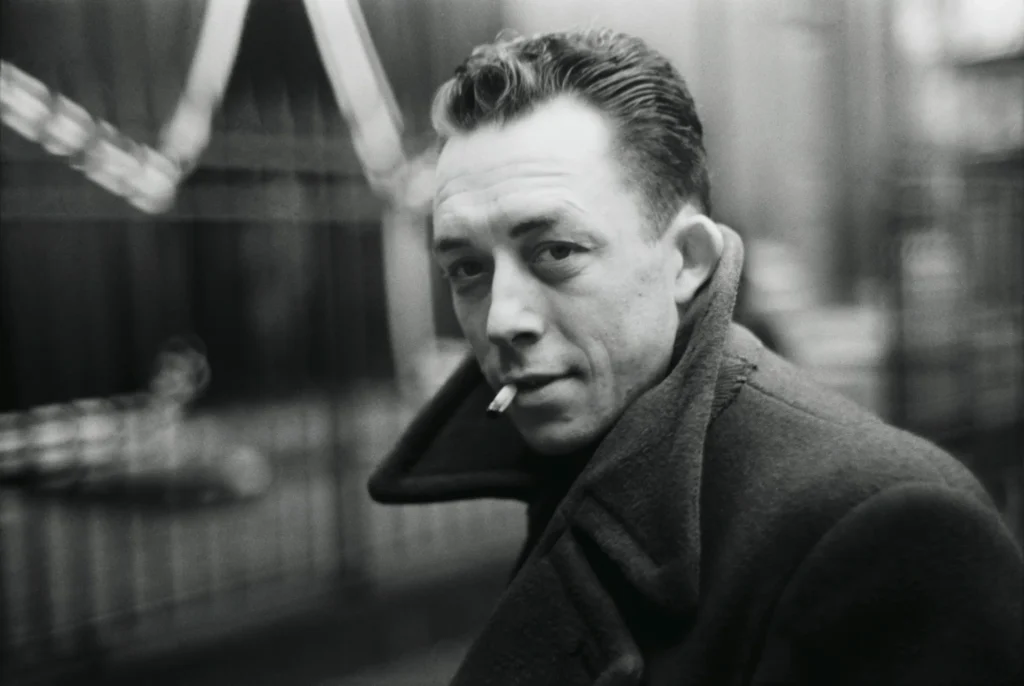
The French philosopher Albert Camus would understand the wife’s decision very well. Camus once declared, “There is but one truly serious philosophical problem, and that is suicide. Judging whether life is or is not worth living amounts to answering the fundamental question of philosophy”.7
Later in the same essay, Camus writes, “Living, naturally, is never easy. You continue making the gestures commanded by existence for many reasons, the first of which is habit. Dying voluntarily implies that you have recognized, even instinctively, the ridiculous character of that habit, the absence of any profound reason for living, the insane character of that daily agitation, and the uselessness of suffering.”8
Let’s say there is no God, and there is no grand cosmic metanarrative which promises a hopeful future that vindicates all our suffering. Moreover, our existence is an accident, and so there is truly no goal or purpose “out there” for us. If this is so, then why endure all the suffering? The nihilist says, there is no point in enduring. But the father is no nihilist. And even though he couldn’t save his wife, he refuses to die himself, and he makes his life solely about his son.
Carrying the Fire
You might be surprised to hear that The Road is actually one of McCarthy’s more optimistic novels. This is because the father does not resign himself to either the empty life of the wanderer or the self-destruction of the nihilist. He realizes there has to be some sort of reason for carrying on that’s deeper than the mere robotic drive to keep living. His wife recognizes this, as well. Before her death, she says,
“The one thing I can tell you is that you wont survive for yourself. I know because I would never have come this far. A person who had no one would be well advised to cobble together some passable ghost. Breathe it into being and coax it along with words of love. Offer it each phantom crumb and shield it from harm with your body.”9
The father chooses to live for his son. He tells his son: “My job is to take care of you. I was appointed to do that by God. I will kill anyone who touches you.”10
He also tries to give his son some sort of hope to cling to. He tells his son that they are “carrying the fire”, a phrase which seems to represent their determination to live, be good people, and hope for a better future:
“We’re going to be okay, arent we Papa?
Yes. We are.
And nothing bad is going to happen to us.
That’s right.
Because we’re carrying the fire.
Yes. Because we’re carrying the fire.”11
Pooja Singal argues, “Even in the most miserable circumstances which he can’t control, the man chooses existence, he chooses life for his son…The father chooses to have a project for both of them-to be the ‘keepers of the fire,’ and to be one of the ‘good guys’-in the face of dread.”12
Do you think this is a good enough reason to justify living? I always thought it was touching, but I think it fails. “Carrying the fire” is not anchored in anything substantive. The father’s “project” is his own subjective narrative that he chooses for himself and his son. But since this project is subjective, it is not true for everyone. It is just the existentialist answer to the meaning of life: you make it up for yourself.
But is that really what we’re looking for when we ask if life has meaning, and if life is worth living? I think the (secular) existentialist approach to the problem of meaning is an abject failure. It is a mere restatement of the problem. The problem is that (given atheism) life seems to lack objective meaning, and so all we have is subjective meaning: our own imaginary stories, no different than a child’s game of make-believe.
Just think of the philosophical duel between the man and his wife. The man can tell his son to live in order to “carry the fire”, but this only works insofar as his son buys into this narrative. But what if someone rejects it? If the meaning of life is subjective, then what do you say to someone who prefers death? The wife presses her husband on this, and he has no answer for her:
“As for me my only hope is for eternal nothingness and I hope it with all my heart.
He didnt answer.
You have no argument because there is none.”13
And later, the father admits:
“She was right. There was no argument. The hundred nights they’d sat up debating the pros and cons of self destruction with the earnestness of philosophers chained to a madhouse wall.”14
So the construction of a fictitious subjective narrative is really no better than the directionless life of the wanderer. There is no substance, if atheism is true, to the phrase “carrying the fire”. There is nothing to stop someone from taking death as a lover. And if the decision to live is just as arbitrary as the decision to die, then we are lost. All the pretty slogans in the world (think of, “one must imagine Sisyphus happy”) will not save us.

Meaning is Found Elsewhere
As a Christian, I’d be remiss if I didn’t mention the biblical solution to our problem here. But first, here is a concise biblical restatement of our problem (try teaching this one at Sunday school):
“‘Meaningless! Meaningless!’
says the Teacher.
‘Utterly meaningless!
Everything is meaningless.'” (Ecclesiastes 1:2).
In his commentary on this verse, the Old Testament scholar John Walton explains:
“Modern readers are inclined to read statements like this through the lens of existential pessimism, amounting to a statement meaning ‘life is not worth living.’ If the Teacher is prefiguring stoicism, however, his point is not so much on the ‘lack of meaning in everything that is’ and more on ‘meaning is found elsewhere.’ The stoic objective is not existential despair, but the devaluing of things to which most (nonphilosophers) assign value, so that the real value of really valuable things (virtue and philosophy for stoics, fear of the Lord for Ecclesiastes) can be properly demonstrated.”15
This is the task of the Christian existentialist: not to depress people, but to destroy their hope in the things of this world, so that people “may know [Christ] and the power of His resurrection” (Phillippians 3:10). For, “In Him was life, and that life was the light of all mankind” (John 1:4). We want to give people real hope, which, as William Lane Craig argues, can indeed be found in Christianity:
“According to the Christian worldview, God does exist, and man’s life does not end at the grave. In the resurrection body man may enjoy eternal life and fellowship with God. Biblical Christianity therefore provides the two conditions necessary for a meaningful, valuable, and purposeful life for man: God and immortality.”16
We do not have to be wanderers slogging along the road with no end in sight, or nihilists aching to kill ourselves at the first opportunity we get, or existentialists with flimsy slogans. We have Christ, and that is why we live: to glorify and love Him, and to be loved by Him in return. As McCarthy puts it: “If he is not the word of God, God never spoke.”17
- Cormac McCarthy, The Road, 168. ↩︎
- Wye Oak, “We Were Wealth,” recorded March 2011, track 9 on Civilian, Merge Records, audio. ↩︎
- McCarthy, The Road, 169. ↩︎
- Ibid, 56. ↩︎
- Ibid, 56. ↩︎
- Ibid, 57. ↩︎
- Albert Camus, The Myth of Sisyphus, 10. ↩︎
- Ibid, 11-12. ↩︎
- McCarthy, The Road, 57. ↩︎
- Ibid, 77. This quote seems to imply that the man’s motivations are theistic in nature, rather than “secular existentialist”. But as Pooja Singal argues, “The man believes that if there is a God, and
if there is meaning, it is found in his son, and nowhere else” (Pooja Singal, “Existentialism in Cormac McCarthy’s The Road“, International Journal of Research 6, no. 4 (2019): 191). So the man’s existentialist narratives seem more fundamental than his theism; it seems that the man dictates what God’s will is. ↩︎ - Ibid, 83. ↩︎
- Singal, “Existentialism in Cormac McCarthy’s The Road“, 191. ↩︎
- Ibid, 57. ↩︎
- Ibid, 58. ↩︎
- John Walton, NIV Cultural Backgrounds Study Bible, 1074. Emphasis mine. ↩︎
- William Lane Craig, Reasonable Faith, 86. ↩︎
- McCarthy, The Road, 5. ↩︎
1 Comment on The Road: Is Life Worth Living?