C.S. Lewis critiques the self-destructive philosophy of naturalism in the The Silver Chair, a book in the Chronicles of Narnia series.
You don’t need to be a historian to know that we humans have a penchant for destroying ourselves. We start pointless wars, or shoot up deadly drugs, or waste our lives on social media. But this devotion to self destruction is not just physical in nature. It is also philosophical.
Intellectual movements throughout history have deliberately attacked the idea that human beings are special, and that our lives are deeply meaningful, and that we have something transcendent and eternal to anchor our hope in. Philosophical suicide comes in many forms, but much of it derives from the broad worldview of “strong” naturalism, which basically argues that the physical world is all there is to reality. All sorts of bitter fruit grows from this assumption, like skepticism, atheism, and moral nihilism.
C.S. Lewis understood this worldview all too well. He confronts its self-destructive logic in The Silver Chair, a novel in the The Chronicles of Narnia series. In this story, our protagonists Jill Pole, Eustace Scrubb, and Puddleglum travel to the strange land of Underland, which is a dark underground civilization populated by the miserable looking people called Earthmen. Here, away from the sunny lands of Narnia, the greatest test that our heroes face is not physical danger, but spiritual apostasy.
A Crisis of Faith
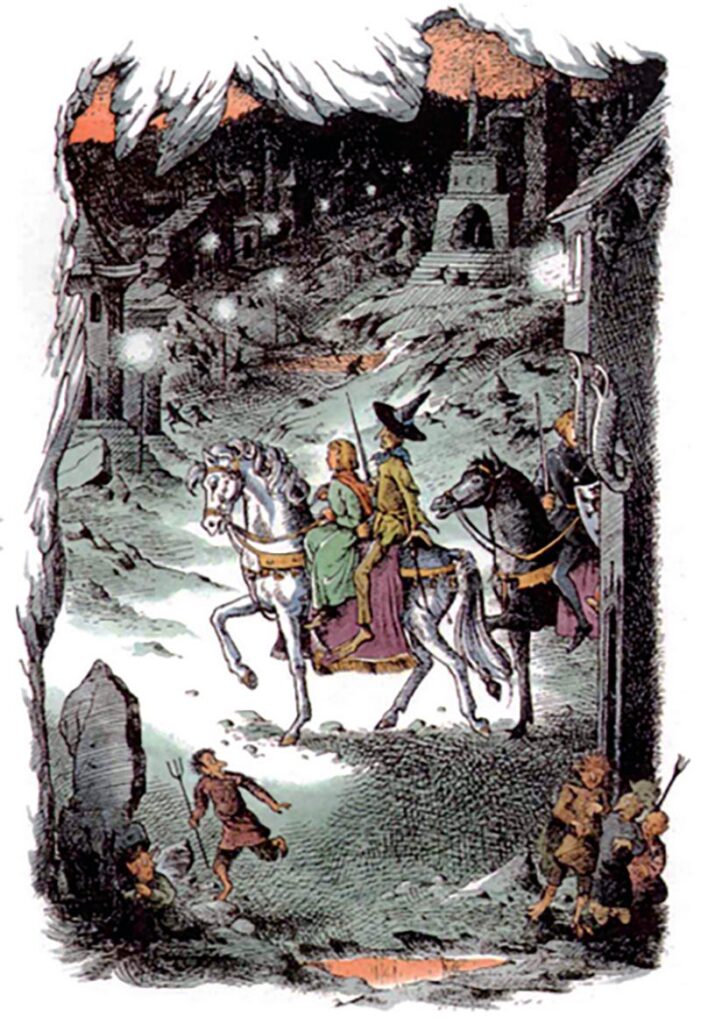
In Underland, Jill, Eustace and Puddleglum free the Narnian Prince Rilian from captivity, thus completing the quest that Aslan sent them on. But before they can escape, the Queen of Underland arrives, the Lady of the Green Kirtle, who is a witch.
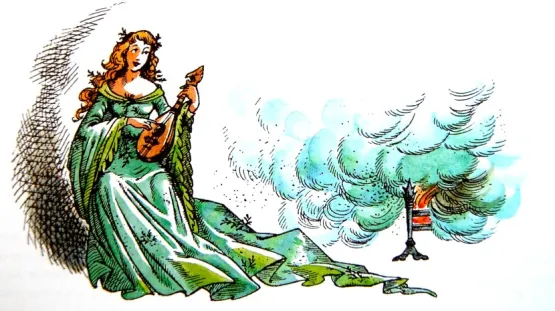
Upon seeing her escaped prisoner, the Witch does not violently attack the heroes. Instead, she throws some magical green powder into the fire, filling the air with a sweet, drowsy smell, which makes it “harder to think.” Then, she starts playing a mandolin-like instrument, which also makes it hard to think. Finally, she begins to question their beliefs about “Narnia” and “the Overworld” and “Aslan”, making our heroes doubt whether or not these things have ever existed.
The Witch begins by questioning the existence of Narnia. When Puddleglum protests that he knows he has been there once, as he distinctly remembers seeing the sun , the Witch pivots to questioning the existence of the sun. Since they are underground, nobody can point to the sun to verify its existence, and so they have to use analogies to explain it to the Witch. The sun is like the lamp in this room, only far greater and brighter, Prince Rilian says. The Witch laughs at this and says:
“You see? When you try to think out clearly what this sun must be, you cannot tell me. You can only tell me it is like the lamp. Your sun is a dream; and there is nothing in that dream that was not copied from the lamp. The lamp is the real thing; the sun is but a tale, a children’s story.”1
This conclusion is absurd; Jill, Eustace, and Puddleglum have been seeing the sun their entire lives. But in the Underland, in the utter darkness, and under the influence of the magic green powder, and the mandolin, and the Witch’s soft, sorcerous voice, our heroes are eventually convinced to deny the existence of the sun. But it doesn’t end there. Jill, in defiance of the Witch’s narrative, declares that “there’s Aslan”. So then, predictably, the Witch begins to sow doubt about the existence of Aslan and even lions in general. She says:
“We should do no better with your lion, as you call it, than we did with your sun. You have seen lamps, and so you imagined a bigger and better lamp and called it the sun. You’ve seen cats, and now you want a bigger and better cat, and it’s to be called a lion. Well, ’tis a pretty make-believe…And look how you can put nothing into your make-believe without copying it from the real world, this world of mine, which is the only world. But even you children are too old for such play.”2
The Witch is so condescending, isn’t she? And yet, it’s her arguments that should be laughed at. Obviously there’s a sun! Obviously there are lions! But the Witch’s magic is too powerful, and by this point it seems as though our heroes will completely succumb to her deceit.
Philosophical Parallels
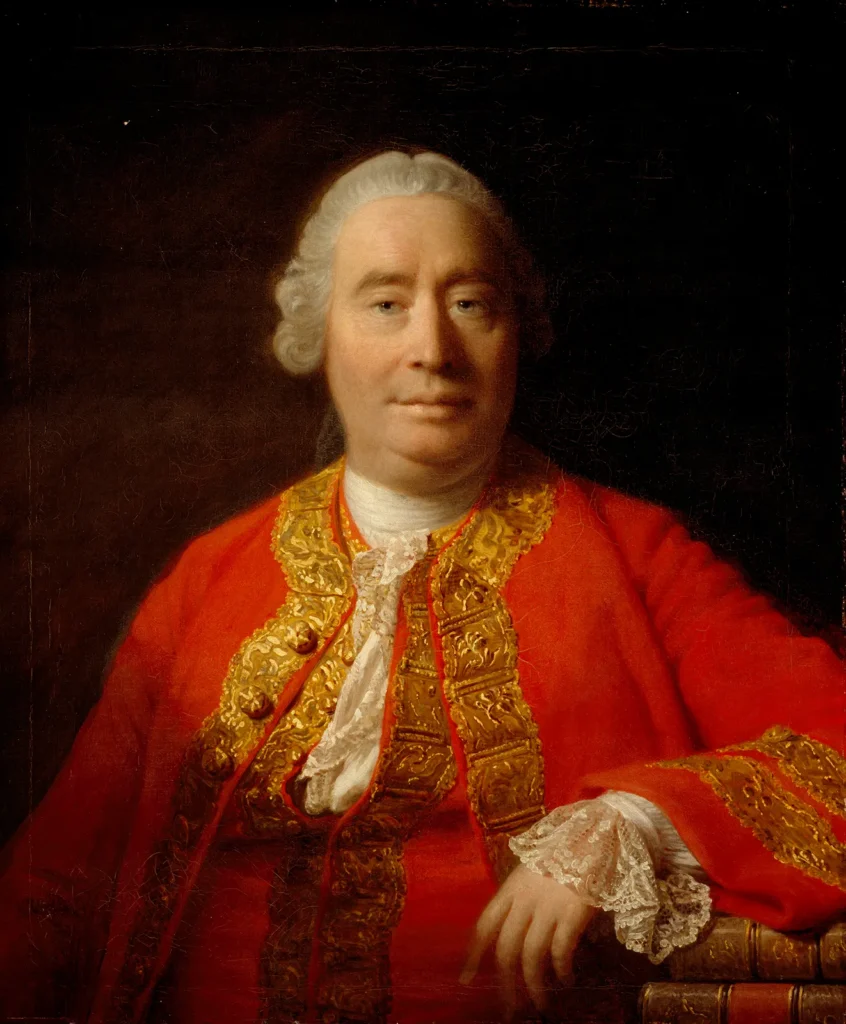
Read some naturalist philosophy, and you’ll start to hear some eerie parallels between their arguments and those of the Witch’s. For example, Lewis was no doubt inspired by the 18th century Scottish philosopher David Hume when he wrote the Underland passages. Hume is well known for his skepticism, and he doubted all sorts of things, from miracles to inductive reasoning to the reality of cause and effect relationships. His skepticism arguably came from his naturalist worldview.
Hume famously made a distinction between what he called “impressions” and “ideas”. According to C. Stephen Evans, “Impressions then are what we immediately experience, either through the senses or by attending to our own minds.” So an impression would be the sweetness we taste when we bite a pineapple. “Ideas” are copies of impressions. We construct our ideas or concepts based on sensations we have had in the past. I have seen a horse before, as well as an animal horn, and so I combine the two and come up with a unicorn.3
Doesn’t this sound familiar? According to the Witch, the “sun” and “lions” are nothing but ideas, or imaginative constructions of things that have already been experienced, such as lamps and cats. And just as the Witch declared “there is no sun”, Hume’s philosophy led him to make some interesting claims himself. For example, Hume thought that the “self” doesn’t really exist. In other words, you and I don’t really exist. Evans explains, “The self for Hume is really just a ‘bundle of perceptions.’ We are just a stream of psychological events following each other rapidly.”4
It’s common to find this Humean skeptical attitude in naturalist literature. Just take a look at two examples:
First, the psychologist Sigmud Freud famously argued that belief in God was a form of “wish fulfillment”. He writes, “the terrifying impression of helplessness in childhood aroused the need for protection-for protection through love which was provided by the father; and the recognition that this helplessness lasts throughout life made it necessary to cling to the existence of a father, but this time a more powerful one. Thus the benevolent rule of a divine Providence allays our fear of the dangers of life…”.5 So, our “heavenly father” turns out to just be a psychological projection; we take the best traits from our earthly fathers and use them to construct God. Again, here we see echoes of the Witch’s arguments against the sun and lions.
Second, speaking about the existence of the soul, M.H. Sabatés sneers, “‘Immaterial mind’ or ‘soul,’ like ‘élan vital,’ ‘elf,’ or ‘chupacabras,’ are ghostly expressions that come from mistaken frameworks or conceptions and do not refer to anything.”6 Remember how condescending the Witch was? Well, this kind of dismissive attitude towards anything non-physical (like souls and God) can be pretty common among naturalists.
So, once the Witch gets our heroes to admit that there is no sun, no Narnia, no Aslan, what then? If naturalists get us to admit that there is no soul, no miracles, no God, what then?
The Horror of Underland
Underland is a dark, miserable place populated by miserable people. And no wonder. They have no sun to give them light or warmth, no Narnia to roam freely around, and no Aslan to protect and love them. They are living in a dead wasteland. And if Jill, Eustace, Rilian and Puddleglum were convinced to abandon their most precious beliefs, they would be trapped in this wasteland by choice. They would essentially be comitting philosophical and spiritual suicide, depriving themselves of all that is good, true and beautiful.
And if we deny the existence of our own souls, we deny what makes us special in the world. We are nothing but clumps of flesh bound together by chemical reactions, and there is nothing special about that. If we deny the existence of God and the afterlife, then we exist for no purpose, and our lives are absurd and meaningless. If we follow the naturalist’s gameplan, then we imprison ourselves in Underland, a cold, dark abyss deprived of hope and joy. We commit philosophical and spiritual suicide.
But thankfully, our heroes choose to spare their own lives.
Puddleglum stamps on the fire which the Witch threw the green powder in. This reduces the enchanting smell that the powder caused, and fills the air with the unechanting smell of Puddleglum’s burnt foot. He then declares,
“Suppose we have only dreamed, or made up, all those things—trees and grass and sun and moon and stars and Aslan himself…Then all I can say is that, in that case, the made-up things seem a good deal more important than the real ones. Suppose this black pit of a kingdom of yours is the only world. Well, it strikes me as a pretty poor one…I’m on Aslan’s side even if there isn’t any Aslan to lead it. I’m going to live as like a Narnian as I can even if there isn’t any Narnia.”7
The Witch’s plot is foiled, and after that she decides to attack them physically in the form of a snake. Our heroes defeat her and escape the Underland.
Enchantments or Eternity
After I read this story, I wondered, is there any parallel to the Witch’s sweet smelling powder and sweet sounding mandolin in naturalist philosophy? What, if anything, could be attractive or seductive about the miserable, denuded, nihilistic philosophy of naturalism? What about naturalism enchants us?
Lewis’s thoughts in his book The Weight of Glory may give us a hint. He writes, “We are half-hearted creatures, fooling about with drink and sex and ambition when infinite joy is offered us, like an ignorant child who wants to go on making mud pies in a slum because he cannot imagine what is meant by the offer of a holiday at the sea. We are far too easily pleased.”8
If naturalism is true, and there is no God, and we aren’t special, then we don’t have any special role to play in the world and no special obligations to fulfill. And that means that we can do whatever we please. We can chase all the pleasures of life without worrying about the afterlife. And with this enchanting smell in the air, maybe we can be tempted to buy into naturalism. Maybe we can say, “there is no sun.”
So what will we do? Will we give in to the enchantment and destroy ourselves in Underland? Or will we stamp on the fire and expose naturalism for what it really is, and hold on to the hope of a greater joy to come?
And I want to make it clear that I am not encouraging some sort of strong fideism or religious subjectivism here, or any kind of view which tells us to persist in faith even if our religious beliefs turn out to be false. Ironically, this view is actually an unbiblical one, as Paul says in 1 Corinthians 15:17-19: “And if Christ has not been raised, your faith is futile; you are still in your sins. Then those also who have fallen asleep in Christ are lost. If only for this life we have hope in Christ, we are of all people most to be pitied.” So I disagree with Lewis, speaking through Puddleglum, that “I’m on Aslan’s side even if there isn’t any Aslan to lead it”. If you’re this person, then by the very words of the Apostle Paul himself, you are “most to be pitied”.
But I also think that there is a way to salvage what Puddleglum is saying. We shouldn’t persist in faith if it turns out that our religious beliefs are false. But it may be that the current evidence appears as though it is against Christianity, or theism, and the data and arguments we have seem to favor naturalism. Or maybe things are just 50/50: the evidence can go either way. In this case, I do want to say, as Blaise Pascal argued, that we should hold on to our faith. The eternal joy that Christianity offers is incommensurably superior to the grim Underland of naturalism. Under the shadow of philosophical suicide, we must fight for our lives.
So I say, in Puddleglum fashion, that even a desperate hope for the eternal God is better than any enchantment that the godless forces of this world can conjure up.
- C.S. Lewis, The Silver Chair, 178. ↩︎
- Ibid, 180. ↩︎
- C. Stephen Evans, A History of Western Philosophy, 337-338. ↩︎
- Ibid, 350-351. ↩︎
- Sigmund Freud, The Future of an Illusion, 30. ↩︎
- M.H. Sabatés, “Reductionism in the Philosophy of Mind”, Encyclopedia of Philosophy, Retrieved from http://www.encyclopedia.com/humanities/encyclopedias-almanacs-transcripts-and-maps/reductionism-philosophy-mind. ↩︎
- Lewis, The Silver Chair, 182. ↩︎
- C.S. Lewis, The Weight of Glory. ↩︎
No Comments on The Silver Chair: Naturalism and Self Destruction