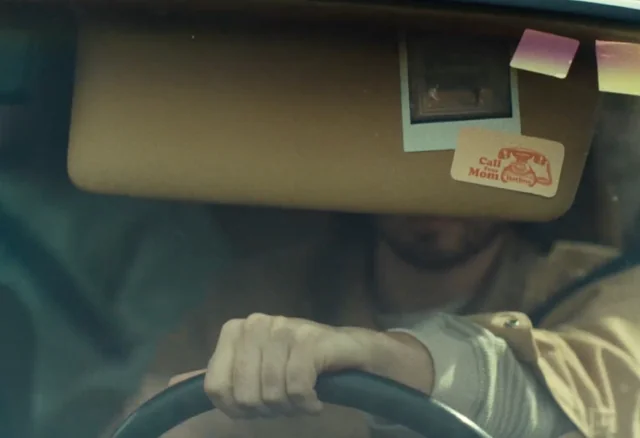
Noah Kohan’s music explores themes of religious trauma, spiritual divide, and the impact of religion on friendship.
The Great Divide
Now with the two songs in our rearview, we shall now see the possible connections. First, Kahan mentions self harm and a car crash. He sings:
We got cigarette burns in the same side of our hands, we ain’t friends
We’re just morons, who broke skin in the same spot
But I’ve never seen you take a turn that wide
And I’m high enough to still care if I die1
Secondly, Kahan also mentions that the one friend, maybe the one who stayed in the hometown and who battled with suicidal alienation, failed to understand his friends life:
You know I think about you all the time
And my deep misunderstanding of your life
And how bad it must have been for you back then
And how hard it was to keep it all inside2
Thirdly, the friend, who found absolution in religion, may have done so only through imperfect contrition due to the moral injury he received in the car accident. He may also have grown up experiencing religious trauma. Kahan sings,
I hope you settlе down, I hope you marry rich
I hope you’re scarеd of only ordinary s***
Like murderers and ghosts and cancer on your skin
And not your soul and what He might do with it3

The interpretation can vary, as I myself wonder if this worry for his own soul comes from a deep moral injury or from religious trauma or both. Fourthly, we get some clues about how the friend feels towards religion. Echoing the hurt found in “Orange Juice,” Kahan sings,
I hope you threw a brick right into that stained glass
I hope you’re with someone who isn’t scared to ask
I hope that you’re not losing sleep about what’s next
Or about your soul and what He might do with it4
Once again, the interpretation is unclear. The stained glass could refer to a church or it could refer to mentally seeing through a stained glass due to one’s mental health, and the friend wishing for the stained glass to be destroyed so that the friend can see clearly.5 I think the correct interpretation, due to the religious connections in the song itself and in “Call Your Mom” and “Orange Juice”, is that the stained glass is of a church. If this is so, then it seems that the friend who stayed in the hometown desires for his friend to abandon his religion. And it seems that the primary reason for the severance of the friendship isn’t the traumatic event itself but a great spiritual divide.
The Great Spiritual Divide
One’s faith often separates; in fact, sociology and psychological studies demonstrate that boundaries and separation is almost necessary for community and identity to exist.6 Paul understood this when he wrote to the Corinthians. He writes, “I wrote to you in my letter not to associate with sexually immoral people — not at all meaning the people of this world who are immoral, or the greedy and swindlers, or idolaters. In that case you would have to leave this world. But now I am writing to you that you must not associate with anyone who claims to be a brother or sister but is sexually immoral or greedy, an idolater or slanderer, a drunkard or swindler. Do not even eat with such people” (1 Cor. 5:9-11).
Paul speaks of not associating with people inside the church that do not follow Jesus’ commands. However, Paul does recognize that Christians must associate with all people – believer or not. Today we have a dichotomy between private faith and the rest of our lives. This dichotomy is a later approach to religious life and did not exist in the first century. Religious life was one’s life, it carried over into all aspects of one’s life. One’s religious life has a deeper impact on relationship then trauma or shared history does and this is exactly what Noah Kahan’s song portrays. The telos of a person’s religious life demands that he walks on a different road. This goes for all people, not just Christians. What we bow down to, what we give priority to, directs our path no matter who we are!
Because of this, a great divide does exist and is bound to show up in friendships that have different values. As C.S. Lewis remarked, “That is why those pathetic people who simply ‘want friends’ can never make any. The very condition of having Friends is that we should want something else besides Friends. Where the truthful answer to the question Do you see the same truth? would be ‘I see nothing and I don’t care about the truth; I only want a Friend,’ no friendship can arise- though Affection of course may. There would be nothing for the Friendship to be about; and Friendship must be about something, even if it were only an enthusiasm for dominoes or white mice. Those who have nothing can share nothing; those who are going nowhere can have no fellow travelers.”7
With this said, this should not stop one from saying hi and loving his friends, no matter their friends life choices, when roads cross. When roads cross, one can simply say “we’re just glad you could visit” or “I hope you settle down and marry rich.” But, as Noah Kahan’s friend points out, some times one can’t say hi because of the possibility of stumbling off the road. For the friend, alcohol is too much of a temptation and the friend ought to understand this and have sympathy. Paul recognizes this when he talks about eating meat sacrificed to idols (1 Cor. 8). For such moments, both the unbeliever and believer should use reason in love to go about their relationship.
Now, Noah Kahan also brings up Hell and the fear of it that his friend has; however, as they exist across a divide, they may misunderstand one another.
Religious Trauma and Misunderstandings
Throughout the three songs, we only hear from the perspective of the non-religious friend. Although the friend was fine with his friend “swearing his soul to Jesus,” it does seem that there exists anger for Jesus taking the number one spot. Is it possible that the friend singing builds a straw man for his friend’s faith as he thinks he is only religious because he is fearful for his soul? This could be a misunderstanding as there are often infinite misunderstandings across a great divide. Strawmanning one’s belief system, whether religious, non-religious, or anti-religious, is something we ought to never do. It could also be possible that the friend does only believe in Christ because he fears for his soul, resulting in imperfect contrition. This leads to the discussion taken up by many fans of Noah Kahan about religious trauma.
To this, I wish to provide an antidote to the problem of religious trauma within church culture. On Hell, C.S. Lewis said, “There is no doctrine which I would more willingly remove from Christianity than this, if it lay in my power.”8 God Himself would gladly get rid of Hell (Ez. 33:11). Secondly, the culture and the church have a massive misunderstanding on what Hell is and we ought to fix this through scriptural teaching rather than continuing in conceptions of Hell from Christian/Greek folklore such as Dante’s Inferno. Thirdly, Jesus speaks of the Kingdom of Heaven/God more than one hundred times while he speaks of Hell only 11-12 times. The church should reflect this! The church, like God, should desire for there to be no Hell and emphasize the Kingdom over Hell, but we also must not shy away from hard scriptural passages.
We must do this in a way that avoids real trauma. The church goer should not feel like God is an abusive father who will whip him with a belt anytime that he disobeys; rather, God is a father who calls his scared child out from the bed to hug him and to tell him that he loves him. What God calls His church to do is to model Christ and Christ did not come to condemn the world but to save it (Jn. 3:17). Jesus Himself makes an interesting note that it is people’s words that condemn, not Himself (Jn. 12:47-48). We ought to incorporate nuances in how we speak about hell such as incorporating other historical positions such as annihilationism and waiting to teach such doctrines to people of a suitable age. Lastly, we must get clear that it is not God that sends one to Hell.

Noah Kahan, while getting music right, gets theology wrong as he thinks God sends one’s soul to Hell, but this is not the case. C.S. Lewis seems to pull from John 12 when he writes, “Hell begins with a grumbling mood, always complaining, always blaming others… but you are still distinct from it. You may even criticize it in yourself and wish you could stop it. But there may come a day when you can no longer. Then there will be no you left to criticize the mood or even to enjoy it, but just the grumble itself, going on forever like a machine. It is not a question of God ‘sending us’ to hell. In each of us there is something growing, which will be hell unless it is nipped in the bud.”9
It is the grumbling that condemns us. It is the abuse of alcohol that creates Hell. If the abuse is not nipped in the bud, then that alcoholic misery shall remain for all eternity. When we teach on Hell, we ought to be clear that it is sin (missing the mark), that puts one a trajectory towards hell, and that it is God who calls us to repent (to turn) so that we can hit the mark! While some may still accuse the church of causing trauma for simply teaching about sin and eschatological realities and will refuse to engage in dialogue, the church ought to still conversate with all people willing to listen and understand. Ultimately, there will be divides, something that Noah Kahan knows well, but these divides do not need to sever hospitality, friendship, and love. If this happens, then we miss the mark and that is exactly what God calls us not to do!
- Noah Kahan, “The Great Divide,” (Mercury Records, 2026), audio. ↩︎
- Ibid. ↩︎
- Ibid. ↩︎
- Ibid. ↩︎
- https://genius.com/38485682 ↩︎
- Haslam SA, Fong P, Haslam C, Cruwys T. Connecting to Community: A Social Identity Approach to Neighborhood Mental Health. Pers Soc Psychol Rev. 2024 Aug. 28(3):251-275. doi: 10.1177/10888683231216136. Epub 2023 Dec 26. PMID: 38146705; PMCID: PMC11193917. ↩︎
- C. S. Lewis, The Four Loves, (New York: Harcourt, Brace, 1960). ↩︎
- C.S. Lewis, The Problem of Pain, (London: Centenary Press, 1940). ↩︎
- C.S. Lewis, The Great Divorce, (New York: HarperCollins, 2001). ↩︎
No Comments on Noah Kahan and Religion Part 2