Guillermo del Toro’s Frankenstein (2025) teaches us about death, faith in science, divine hiddenness, and forgiveness.
Guillermo del Toro’s Frankenstein (2025) is a masterpiece and worthy of an Oscar. In fact, it is nominated for nine Oscars and, without a doubt, will win at least a couple. The film tells the well known story of Victor Frankenstein’s mad, ego driven desires to conquer death, and how, in the process, he creates a monster whom he abandons. I cannot comment on how similar the movie is to Mary Shelley’s 1818 novel as I shall have to wait until after grad school to checkmark that off my reading list. However, there are four important themes throughout the film that I wish to comment on: death, faith in science, divine hiddenness, and forgiveness.
DEATH
In the film, Victor has a callous but scientifically brilliant father and a soft and loving mother. The abandonment of his father creates the medical complication that kills Victor’s mother during the childbirth of his younger brother William. This death, and Victor’s failing to save her, puts into him the motivation to overcome mortality. Oddly enough, death may be what motivates all of us in all that we do.
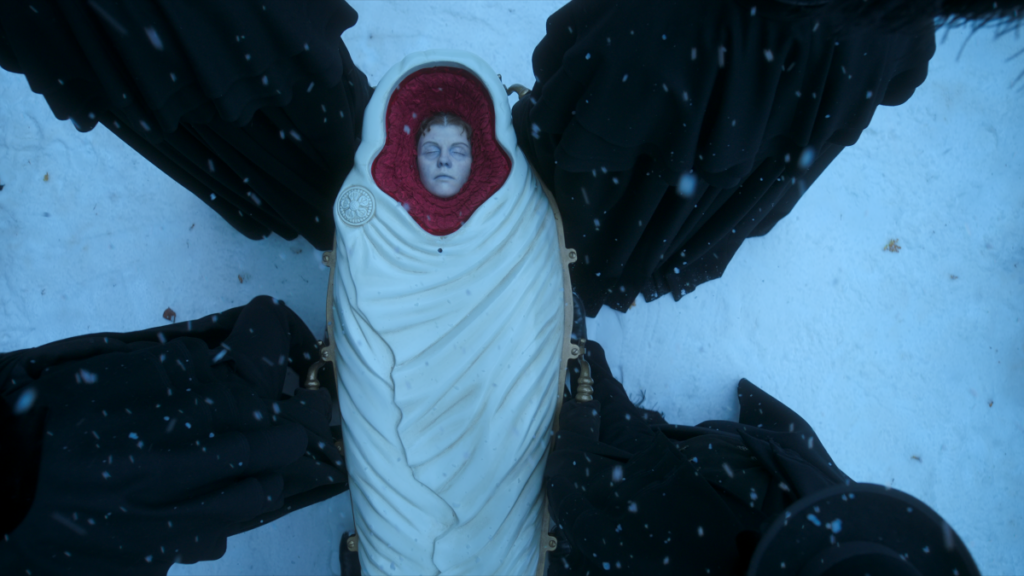
The Pulitzer prize winning archeologist Ernest Becker states, “the idea of death, the fear of it, haunts the human animal like nothing else: it is the mainspring of human activity – activity designed largely to avoid the fatality of death, to overcome it by denying in some way that it is the final destiny of man.”1 He continues, “all culture, all man’s creative life-ways, are in some basic part of them a fabricated protest against natural reality, a denial of the truth of the human condition, and an attempt to forget the pathetic creature that man is.”2
All culture is shaped by death, without it, culture would not exist. Most of our choices are subconsciously shaped by death. Hedonistic pleasure, virtuous pursuits, our stories, our health, our relationships, and our religious devotion (both atheistic and theistic) are all driven by the inevitable future that death overtakes all. Death, it terrifies us into searching for life.
Ancient stories echo this terror. In the Ancient Epic of Gilgamesh, Gilgamesh says, “how can I rest, how can I be at peace? Despair is in my heart. What my brother is now, that shall I be when I am dead. Because I am afraid of death.”3 The critic in Ecclesiastes groans over death and suffering and its seemingly unfair character, and even states that it is better for one to never have been born at all (Ecc. 4:3). Today, more than five hundred studies demonstrate that we are deeply affected by the terror of our knowledge of our own mortality.4 Death can be a great thing to meditate on (Ecc. 7:4), but we often choose incapable and damaging antidotes when we should choose Him as the antidote.
Victor, while presenting his ability to raise the dead to university faculty, beckons, “God is inept, and we must correct his mistakes!” This causes the university to expel him; however, he finds a funder in Heinrich Harlander, and both turn to science to settle their despair over death.
FAITH IN SCIENCE
Frankenstein has always been taken as a cautionary tale against scientific ambition and the people who, as Elizabeth says, “play God”. Today, the scientific ambition to play God is at an all-time high. Transhumanism, a philosophical movement that seeks the promise of immortality through technologies’ ability to overcome human limitations, is where Victor puts his faith. Today’s pioneers do the same. Oracle cofounder Larry Ellision donated $430 million to antiaging research, and Alphabet CEO Larry Page started Calico with a $750 million investment for life-extension research.5
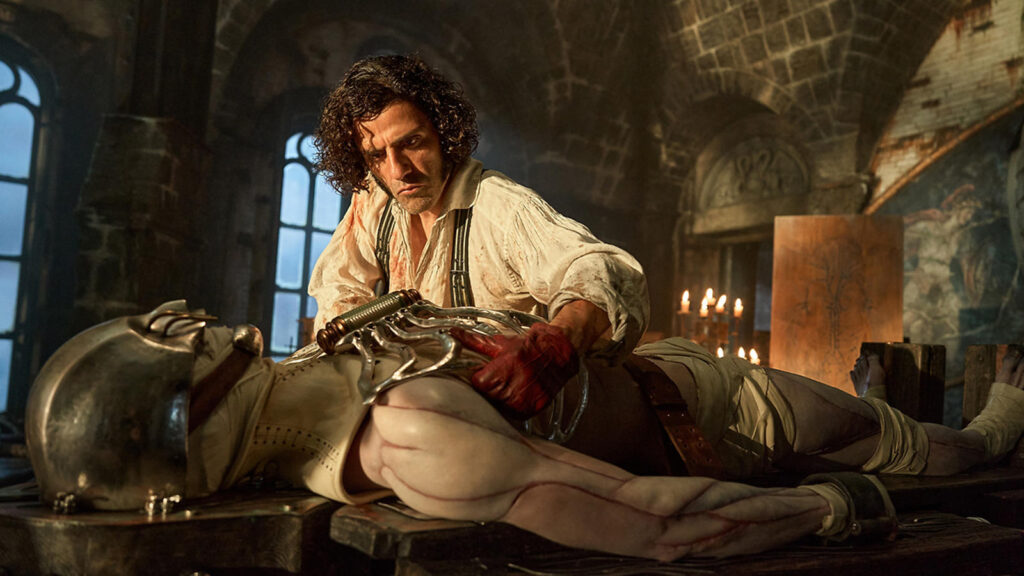
Some put faith into “brain-uploading”. David J. Chalmers, professor of philosophy and neural science at New York University, states that one day, during the “singularity”, that we will be able to upload our brains to a computer, giving us immortality. However, Chalmers also recognizes that we have no idea how to go about consciousness and therefore, brain uploading. He says, “it is true that we have no idea how a nonbiological system, such as a silicon computational system, could be conscious. But the fact is that we also have no idea how a biological system, such as a neural system, could be conscious. The gap is just as wide in both cases.”6 Transhumanism relies on the metaphysical commitment of materialism, but perhaps we have this wide gap because we are much more than simply material beings.
Any time we reduce man to material, we will end up in evil. Victor states, “In seeking life, I created death.” Instead of seeking life Himself, he created a monster. However, del Toro does not think of monsters as most do.
A MARCIONITE DIVINE HIDDENESS
Del Toro connects more with monsters than with Jesus. He says, “monsters are my religion… my grandma has Jesus. I have Boris Karloff. He was my Messiah.”7 He also thinks of monsters as patron saints and sees Frankenstein as Christ. One only has to look at the striking imagery of the monster being crucified:
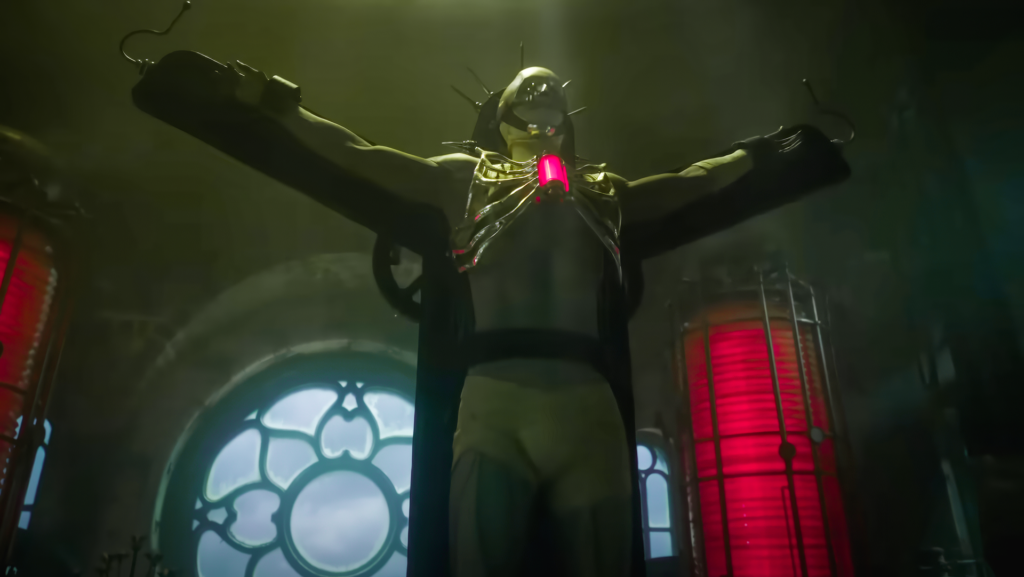
However, under this framework, he conjures a Marcionite-like heresy where Victor is a careless and angry creator who gave no thought to what would come after his creation and the creature is Christ whom comes with love and salvation. It seems that the creator is the one who needs forgiveness, not creation. It seems that it seems as though it is the creator’s fault for the suffering we experience and not creation’s rejection of their creator. The creator abandons his creation and his creation yells “VICTOOOOOOOOOR!” The chasm we see between the divine and us is a true reality, but it is not the creator’s fault.
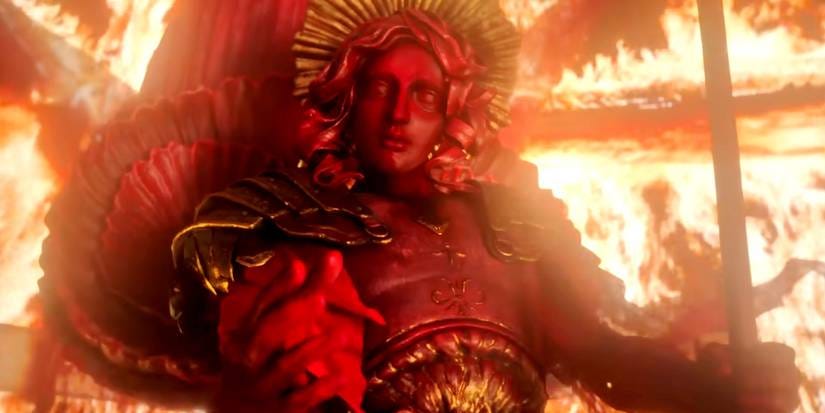
Victor as a child prayed to the archangel Michael as he bowed to a comforting statue of him. However, a bloody, dark angel visits him to inspire his journey of overcoming death. Victor should not be thought of as a God who abandons His creation, rather he should be pictured as Adam and Eve who listened to the dark serpent that told them they won’t die. Victor is us humans who miss the mark in the plethora of ways we try to achieve life.
In the Christian story, it is the Father who had a plan all along to reconcile His creation back to Himself, the plan that the seed of the women would crush the head of the snake (Gen. 3:15). And even del Toro seems to maybe hint at this plan near the end of his film.
FORGIVENESS
Del Toro, a lapsed catholic, cannot rid himself of the Christian ideal of forgiveness. While he may paint God as a negligent creator, the message of forgiveness, that is so central to the Christian faith, is the story’s message as Victor ends saying:
“Forgive me. My son. And if you have it in your heart, forgive yourself into existence. If death is not to be, then consider this, my son. While you are alive, what recourse do you have but to live? Live. Say my name. My father gave me that name, and it meant nothing. Now I ask you to give it back to me… one last time. The way you said it at the beginning. When it meant the world to you.”
The creature responds, “Victor. I forgive you. Rest now, Father. Perhaps now, we can both be human.”
We must forgive ourselves into being. If we do not forgive each other and ourselves, we cannot have life. The Psalmist writes:
When I kept silent about my sin, my body wasted away
Through my groaning all day long.
For day and night Your hand was heavy upon me;
My vitality was drained away as with the fever heat of summer. Selah.
I acknowledged my sin to You,
And my iniquity I did not hide;
I said, “I will confess my transgressions to the Lord”;
And You forgave the [f]guilt of my sin. Selah.
Therefore, let everyone who is godly pray to You in a time when You may be found;
Surely in a flood of great waters, they will not reach him.
You are my hiding place; You preserve me from trouble;
You surround me with [h]songs of deliverance. Selah (Ps. 32:3-7).
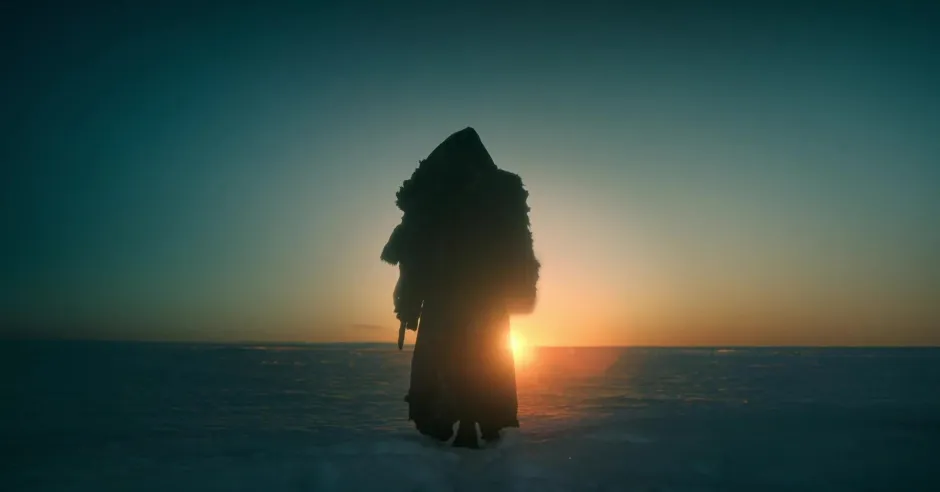
If the creature does not forgive, he will waste away along the bitter, groanful road of unforgiveness that leads only to sheol, the realm of the dead. However, once the creature forgives, he is able to look upon the sun, which, as Victor said, is life. May we, through these stories that shadow the real story, realize the forgiveness we have in Christ as His light preserves, delivers, and gives life to all those brave enough to look upon the Son.
- Ernest Becker, The Denial of Death, (New York: Free Press, 1973), xvii. ↩︎
- Ibid, 32-33. ↩︎
- The Epic of Gilgamesh, translated by N.K. Sanders, (New York: Penguin, 1972), 42. ↩︎
- Sheldon Solomon, Jeff Greenberg, and Tom Pyszcynski, The Worm at the Core: On the Role of Death in Life, (New York: Penguin, 2006), 10-11. ↩︎
- Arina Eunjung Cha, “Tech Titans’ Latest Project: Defy Death,” Washing Post, April 4, 2015. ↩︎
- David Chalmers, “The Singularity: A philosophical Analysis,” in Science fiction and Philosophy From Time Travel to Superintelligence, 2nd. Ed. Susan Schneider (West Sussex, UK: Wiley, 2016), 203. ↩︎
- https://bgindependentmedia.org/mexican-director-del-toro-frames-frankenstein-as-a-father-son-psycho-drama/#:~:text=Review%20by%20CARROLL%20McCUNE,doing%20a%20horror%20movie%E2%80%94ever. ↩︎
Comments Off on Frankenstein (2025)